mind.in.a.box: From Hadwiger to Kreger

mind.in.a.box From Hadwiger To Kreger Header

In 2017, mind.in.a.box released Broken Legacies, featuring songs penned by Josh Kreger instead of the lyricist for their five previous concept albums Markus Hadwiger. Kreger would write the lyrics and supplementary short story for not only Broken Legacies but also the 2023 release of Black and White. This transition from Hadwiger to Kreger was both a stark change in direction and a natural progression of the band’s themes and cyberpunk saga. It had flaws and left behind central elements from the Hadwiger era, but it also brought a narrative strength mind.in.a.box’s story hadn’t seen before and a needed perspective in the current era.

In an interview for ReGen Magazine, music producer Stefan Poiss said he didn’t want to just create electronic music when he signed mind.in.a.box with Dependent Records in 2002. He and lyricist Markus Hadwiger had been creating computer games for the Commodore 64 together for years with Poiss producing the music and Hadwiger programming. Poiss wanted to continue creating worlds in a new medium, and so, he and Hadwiger worked together to create a story that would serve as the backdrop for their first album Lost Alone and all following albums. While they wanted a larger storyline to increase the depth and scope of their music, they also wanted the songs and the emotions they portrayed to stand on their own, leaving them open to the personal interpretation of listeners.

Hadwiger’s subscription to these philosophies shows in his lyrics. The story in mind.in.a.box’s first three albums Lost Alone (2004), Dreamweb (2005), and Crossroads (2007) especially is quite vague. Most songs focus on the emotional experience of the characters, which could be the emotional experience of anyone in any number of scenarios. Only rarely do the songs zoom out to reference the protagonist Agent Black, his pursuit of Night and The Friend, his former boss turned enemy Mr. White, and his search for the Dreamweb.

Hadwiger’s primary profession as a programmer and the ambiguity and fluidity of the story give the impression that he didn’t have much of a vision for it. Many concepts don’t appear until after Poiss and Hadwiger began collaborating with Andreas Gruber, a German novelist who wrote short stories to supplement mind.in.a.box’s website and lyric books for Crossroads (2007), Revelations (2012), and Memories (2015). In an interview with I Die You Die, Poiss suggested that Gruber wrote the supplementary story for Crossroads by listening to the completed album. While it may have never been Hadwiger’s intention, if he had any, this story would become canon as following albums began using terms like “Agent” and “Agency” and making meta self-references to a band called “mind.in.a.box.” These were all in Gruber’s short story but didn’t appear in Crossroads‘ lyrics.

This isn’t to say Hadwiger is a bad writer or lyricist. Many of mind.in.a.box’s best songs are from the Hadwiger era. Both Poiss and Hadwiger are native German speakers from Vienna, Austria conveying emotions and complex topics that connect with English speakers across the world. Hadwiger’s English translation of Gruber’s short story for Memories shows at least as much artistry and mastery as Ned Kirby’s translation of Crossroads‘ short story. Hadwiger laid a beautifully flexible framework for him, his collaborators, his listeners, and his successors to build upon. He just didn’t show much ambition in telling a story of his own.

I should mention this analysis doesn’t include any developments that may have occurred in supplementary material for Revelations. This material was only available on the mind.in.a.box website and doesn’t appear to be accessible anymore. It may have been retired with Adobe Flash Player, which the website used to hide “secret areas” accessible from codes found in the first four albums’ lyric books.

Hadwiger’s first love of programming ultimately transitioned him away from the project. In his interview for Revelations with I Die You Die, Poiss admitted mind.in.a.box’s future was uncertain as so much of it relied on Hadwiger finding time around his day job to write. Unlike previous albums, Poiss credited himself as co-lyricist for Memories, perhaps revealing how thin Hadwiger’s time had been spread. Synthpop Fanatic theorized the density of Memories‘ storytelling was Hadwiger’s attempt to tidy the story before leaving the project, passing his writing duties to Josh Kreger.

Poiss told UNTER-TON in an interview that Josh Kreger was a good friend who contributed lyrics to Poiss’ THYX side project, but besides that, there isn’t much information about him. Considering Poiss and Hadwiger’s 2009 interview with ReGen Magazine was written by one “Joshua Kreger,” he’s likely a journalist, and it shows in his approach to the project. Kreger brought a strong narrative voice and message to mind.in.a.box’s short stories and lyrics. Unlike previous albums where Gruber wrote the short stories and Hadwiger wrote the lyrics, Kreger wrote both the stories and lyrics for Broken Legacies (2017) and Black and White (2023). Broken Legacies continued the tradition of the lyric book story mostly serving as a supplement to the album. Black and White‘s story, however, became such an integral part of the album that it sounds more like a futurepop musical.

Kreger also added his own voice to the music. While he’s uncredited in Broken Legacies, I believe he voices The Friend in “Evasion,” “Ockham’s Razor,” “The Time Has Come,” and “Command: Decode.” He is credited in Black and White where he plays Mr. White in “Just Like You Always Wanted,” who has similarities to the uncredited voice from Broken Legacies.

The largest change Kreger brought to the albums, however, was his approach to mind.in.a.box’s mission: to create music that frees minds of their boxes. Within Broken Legacies‘ story, Kreger reasons that minds can escape their boxes, and thus enter the Dreamweb, through multiple methods, not only by listening to mind.in.a.box’s music as Gruber proposed in Crossroads. Kreger created lore that The Friend found the Dreamweb through intellectual liberation, vigorously uncovering the truth about the Agency — an allegory for the government. While Hadwiger was content with the refrain “the music is the key [to the Dreamweb],” Kreger explained why: mind.in.a.box inspires listeners to consider the various walls that may be enclosing their mind.

Hadwiger’s encouragement to listeners was personal and emotional. His lyrics explored psychological topics such as loneliness, misconceptions, and fears. “Lost Alone,” “Lost Alone 2,” and the Lost Alone (2004) album as a whole, for example, commented on how the Internet had enabled more human connection than ever before but also anonymity and a sense of being alone among a network of minds in boxes. These observations have remained topical over the past twenty years of the Internet’s evolution. For all the technology connecting people together, we live in the midst of a loneliness epidemic. Someone is within reach, someone is observing, but the listener, the singer, or mind.in.a.box’s characters can’t see it.

I can feel your presence,
In the middle of the night.
I share the sadness,
When you are feeling contrite.


I don’t know who you are.

In contrast, Kreger challenged listeners through political commentary. While previous mind.in.a.box albums had hints of its world’s Orwellian dystopia, Kreger would bring this to the forefront as the subject of most songs. The protagonist Black’s fight became not that of overcoming inner personal conflicts with a 1984-like world as a backdrop but that of a literal battle against the Big Brother-like Agency. To escape its box, the mind not only has to uncover and confront its inner demons but also seek the truth about the external world.

While this seems like a stark difference, it’s actually a natural progression of the mind.in.a.box story. Lost Alone and Dreamweb‘s characters were so inwardly focused on their emotions and struggles that the songs hardly referenced where they were physically. As the story progressed, characters gained names and the external world gained details and focus.

Hadwiger’s final album Memories illustrated this transition most. “Travel Guide” retold the entire story from an external perspective rather than its primarily internally focused one. Within the album, several songs can be interpreted as internally focused versions of the external events described in “Up There” where Black is cornered on a rooftop by antagonist Mr. White and his Agents. In “Silent Pain,” Black approaches a metaphorical edge and expresses notions of sacrificing himself to show the Agency forgiveness. As he stands on an actual ledge in “Face It,” he realizes his ambitions of convincing White or his Agents to change their ways are misplaced.

One step up the hill,
One step closer to the edge.

I look down and I see the future,
I look back and I see the past.


We must try to show them,
We must try to forgive them all.
I will sacrifice myself.
It is my gift to a better world.

With Broken Legacies, Kreger would continue transitioning the perspective from external to global. The songs not only described how the characters felt and what they were doing but also the state of the world they inhabited. Songs that didn’t map so easily to one of the characters’ perspectives such as “Stalkers” or “Synchronize” had always existed, but such songs became more prevalent in Broken Legacies and Black and White. “Attack,” “Arcade,” “Integrate,” “Digital Miasma,” “Drowning in the Fire,” and others have little relation to Black, White, Night, or The Friend. Instead, they appear to describe the state of their world and its citizens’ experiences. The shift of focus from internal to external to global illustrates a mind escaping its box, fitting of mind.in.a.box’s themes.

Kreger’s approach has its downsides though. Although fitting for their character arcs, The Friend’s portrayal as a determined and confident leader in Broken Legacies and Black’s resolute insurrection of the Agency in Black and White still contrasts with The Friend’s grief and loneliness in Lost Alone and Black’s uncertainty and disorientation throughout prior albums, perhaps leaving fewer relatable emotions for listeners to grasp. Combined with the increased frequency of external and global perspectives, listeners have fewer opportunities to connect to the music through intimate character viewpoints and emotions.

The more common complaint fans have with Kreger, and that has even turned fans away, is the political commentary itself. Broken Legacies is fairly tame. Its story of oppression under an authoritarian government doesn’t map to the modern world so easily. “Arcade” is the easiest but only as far as its commentary on addiction. Carefully crafted to manipulate emotions and foster addictions, technologies such as social media, video games, and advertising have become obstacles hindering consumers from achieving their dreams.

I swore I’d burn my life onto the world.
I swore I’d never settle for anything less.
But somehow I just can’t seem to stay away from.
This arcade of a life and it’s maniacal caress.

For those familiar with conservative talking points, however, it’s nearly impossible to not hear them in Black and White. Clever lyrics in “New Wave Propaganda,” “Integrate,” and “Inculcation and Immolation” contain common criticisms conservatives level against leftism, those with unshakable belief in liberal ideology, and the intolerant treatment conservatives receive for their views from the so-called tolerant. “Black and White” is a plea to see the gray in a world where the extremes rule. “Sometimes Never” criticizes political figures’ tendency to defend their claims and promises only until it’s inconvenient and then never speak of them again.

A promise speaks truth,
To credulity and youth.
Always is forever,
But sometimes sever.

Forever and always:
Never!

“Digital Miasma” is most damning as an outright parody of mandatory COVID-19 vaccines. Considering Stefan Poiss publicly filed a complaint against the Austrian government’s COVID-19 policies, this interpretation is likely intentional. Needless to say, Kreger and Poiss making their politics obvious within their music — mind.in.a.box escaping its fictitious world into reality — repelled some fans.

As for me, I miss the melancholy and ambiguity of the Hadwiger era. Its emotion combined with its vagueness left much to the imagination and much space for listeners to create their own connections to the music. Its uncertainty and loneliness is repetitive perhaps but no more repetitive than the Kreger era’s politics and retaliation. The topics were merely more human.

While I was considering what a loss Hadwiger was while researching for these articles, however, Charlie Kirk was assassinated. I was not only upset by the murder and loss of such a bright light in the conservative movement and the world as a whole but also disturbed by its celebration. I felt alone and surrounded by heartless people. I was studying Black and White lyrics at the time, and suddenly, “Lost and Alone” became a reminder of the “silent majority’s” existence. The album’s clever wordings of conservative talking points became funny inside jokes. I was reminded that I was not alone, and I was glad Kreger’s voice existed.

We extend a hand to those in need.
We feed the mouths of every creed.
Devoted, watching from above.
Who could stand against love?

Some things that made mind.in.a.box great were left behind in the Hadwiger era, but the brave new Kreger era replaces them with elements just as meaningful. Hadwiger encouraged listeners to examine their misconceptions about themselves, explore their emotions, and find their own interpretations of the story pieces he provided. While Kreger provided relatively confident characters and a stronger narrative, he encouraged listeners to think for themselves, question their beliefs, and seek the truth. While both approaches have strengths and weaknesses, both serve in advancing mind.in.a.box’s mission to free minds from their boxes.
mind.in.a.box releases a new album Retaliation on September 18, 2026.

mind.in.a.box: Crossroads is not about amnesia

Crossroads is not about amnesia header image

mind.in.a.box’s third album Crossroads is about amnesia. The second song is titled “Amnesia.” The short story included in the lyric book reveals the protagonist Black’s memory was wiped between the previous album and Crossroads. In the opening song, Black tells the listener his former boss White “tried to erase my identity.” The band’s official story synopsis, interviews, and many reviews of Crossroads include a remark that this chapter of mind.in.a.box’s science fiction saga is about Black’s amnesia.

Crossroads was the first of mind.in.a.box’s concept albums to include a supplementary short story, and its clarity in comparison to Markus Hadwiger’s esoteric lyrics suggests Black’s amnesia is a fact closed to interpretation. In an interview with I Die You Die, however, mind.in.a.box’s producer Stefan Poiss suggests German science fiction author Andreas Gruber wrote the short story while listening to the completed album. That is, the short story was only an interpretation of Hadwiger’s lyrics and Poiss’ music, not canon at the time. It inspires the listener to seek the story told in the album’s content, but that story doesn’t have to be the one Gruber found.

When analyzed without the supplementary short story, Crossroads doesn’t have to be about amnesia, at least not about any of the events that have transpired since the first album Lost Alone. Instead, it continues a realization Black has from the second album Dreamweb: he is a pawn who discarded his identity long before the albums’ events began.

Evidence for this conclusion begins with mind.in.a.box’s first chapter Lost Alone. This album contains two “story songs”: “Waiting” and “Forever Gone.” Underplayed by atmospheric electronic music, these songs feature a nameless agent reporting his activities in tracking a “he” and “she.” Crossroads names the agent Black and the fifth album Memories formally links the “he” to The Friend and “she” to Night, character names which also begin appearing in Crossroads. For simplicity, I’ll refer to these characters using these names.

These story songs invite the listener to interpret the rest of the album through the perspective of these three characters. Poiss’ vocals and use of vocal effects to portray characters, mental or physical states, dialogue, inner monologues, and subconscious thoughts supports multiple interpretations. One reviewer can interpret all the songs from Black’s perspective. Another can assert only the story songs are part of the storyline and the remaining songs, while fitting the theme, are unrelated. “Walking” can be interpreted as Black’s subconscious thoughts or The Friend’s conscious ones, and “Lost Alone” implies multiple miserable narrators exist, unaware they are lost alone together.

You are not the only one,
Lost alone in this world.
There are others beside you,
Feeling empty and hurt
Feeling empty and hurt.

For me, The Friend is the primary narrator of Lost Alone but, crucially, not the only one. Sung in Poiss’ natural singing voice, the fourth song “You Will See” describes The Friend’s fall from a position of power, causing his partner Night to abandon him. Angered by her shallowness, The Friend vows to return to his place of prominence, but she will never be a part of his life again.

Reviewers often interpret Poiss’ distorted vocals in the second song “Change” as feminine. With this in mind, “Change” depicts Night’s perspective of the relationship’s end. Her reason for ending it has little to do with The Friend’s former position. Rather, it stems from a fear of closeness and the change it brings, fears she misinterprets as selfishness.

I do not need anybody else,
Bonds would put my mind into cells.


I am the one who cries out at night,
For somebody to change my very core.
Not sure why I live in endless fright,
Doomed to love only myself for evermore.

Supporting this interpretation, the opening song “Light & Dark” features two characters, one represented by Poiss’ natural singing voice and the other by feminine vocals, repeating the same lonely refrain.

I feel sad, so left alone.
Words are not enough,
For me to live on.

This and the rest of the album illustrates how the two characters really feel. Despite his spiteful words in “You Will See,” The Friend “Questions” his decisions and becomes so lost in heartbreak that he doesn’t notice Black has placed a trace on him. Black notes this in “Waiting” and also reveals “he is looking for her. We thought he doesn’t know, but now he seems really desperate to find her.” The Friend has determined to reunite with Night it seems, but she has become difficult to reach. She’s escaped to what Black calls “the other side,” the Dreamweb as named in future albums. Black and his nefarious employer pursue The Friend in his desperate quest either to allow him to unwittingly lead them to the Dreamweb or to prevent him from becoming another escapee. Ultimately, in his effort to elude Black and reach Night, The Friend commits suicide, or that’s how it looks from Black’s perspective.

Somebody must have tipped him off.

His body. It was sprawled on the floor.

Either he is dead, or he has switched over.

Unknown to Black, The Friend has escaped the physical world entirely into the Dreamweb as suggested by the taunting lyrics interspersed with Black’s report in “Forever Gone” and by the hopeful lyrics of “Lost Alone 2.” Whether The Friend found Night on the other side or not, he doesn’t feel alone anymore.

Your mind the beacon that guides me,
When I’m lost I know I will find you.
Through the fire that consumes me,
You will know that I’m lost alone too.

The most important song on the album in relation to this analysis, however, is the final song “Leave.” Interpreted from The Friend’s perspective, it doesn’t make sense after the optimism of “Lost Alone 2.” Echoing “Questions,” “Leave” portrays restlessness and confusion.

This is not what I had wanted,
I have to leave this place
This is not what I had dreamed of,
I need to gain more space.

“Tape Evidence,” the opening of the second album Dreamweb, contains strong evidence that “Leave” is Black’s perspective. Although no longer tinny as if spoken through a phone, “Tape Evidence” features mostly spoken words rather than sung lyrics like Black’s reports. This suggests it’s Black complaining his dreams are restless. Interspersed with his narration are snippets from Lost Alone and Dreamweb. Immediately after Black says, “There were many things from my past,” is a clip from “Leave.” When interpreted as Black’s past and therefore his perspective, “Leave” implies he found The Friend’s apparent suicide deeply disturbing.

Besides “Tape Evidence,” Dreamweb provides two story songs for listeners to use as a lens to interpret the rest of the album. In the tenth song “Reflections” Black recounts what has occurred since The Friend “disappeared eight months ago.” Black’s employer White learns through an informant when Night will be at a club. In the eighth song “Dead End,” Black infiltrates the club but falls unconscious under the strange effect of the club’s music while pursuing her. When he awakens, he sees White attaining a tape from someone and leaving Black in the gutter. Black returns home, but the music remains stuck in his head. Then, in the opening song “Tape Evidence,” someone leaves a tape on his doorstep.

The reverse ordering and overlapping of these story beats not only gives context to the other songs but also encourages listeners to consider that the rest of the album isn’t in order either. Additionally, while some songs can be interpreted from The Friend’s perspective, Black becomes the dominant voice as he ponders his failure to attain the secrets of the Dreamweb.

Dreamweb is a character study analyzing what Black found so disturbing about The Friend’s death. Future albums elaborate that Black is an Agent working for an all-powerful, all-controlling Agency. The Dreamweb represents a place beyond the Agency’s control where minds may freely pursue their dreams, a synonym for goals or aspirations. In this way, the Dreamweb album uses the pursuit of the Dreamweb nearly synonymously with the pursuit of one’s dreams, particularly for Black. “Lament for Lost Dreams” reveals Black once had dreams, but unlike The Friend who was so devoted to his dreams that he left the physical world, Black abandoned his.

I cried for what was not meant to be,
A last tribute to lost dreams.


I will thrust my agony aside,
To prepare for a new day.

Black doesn’t say what his dreams were or why he felt he couldn’t reach them, but the following song “Machine Run” suggests that to escape the pain of losing these dreams, he devoted himself to the Agency.

Driven by the need to forget,
You had lost all your dreams.
Running from your pain and regret,
You wanted to escape their web.

“Sun and Storm” suggests that pursuing The Friend filled a void that Black’s employment could not. When The Friend vanished, taking all clues to the Dreamweb with him, Black became aware that the lost dreams he thought he was running from were also the ones he was pursuing. The Friend casts sunlight upon Black’s unhappiness but also a storm of uncertainty as to his identity as an Agent.

You had come to fill the void,
But you always were forlorn.
You had come into my life,
And you brought both sun and storm.


When you fell I had to stay,
But I think I’ve also died.

External forces also fuel Black’s uncertainty. In “Tape Evidence,” Black says, “I can feel them, in my head.” By some interpretations, “them” could be The Friend, Night, or the escapees they represent, what Crossroads calls the Sleepwalkers. Interpreted from The Friend’s perspective, “Out of Time’s” agitation suggests The Friend isn’t content with leaving behind those like Black who are unable to reach the Dreamweb.

No one feels his infiltration,
Always repenting of his crime.
Still stained with desecration,
Forever floating out of time

When he falls unconscious under the Sleepwalkers’ influence in “Dead End,” Black experiences “The Dream” in which The Friend infiltrates his mind.

You fell asleep and now you’re mine.
I feel so helpless and so weak.
Just let go and embrace your dream.
I’ve lost track of what I am.

“The Dream,” however, is also benevolent. Black begins the song lost in his hopeless search. The deep voice invading his mind then tells him truths about his life, and by the end, Black realizes this dream is his. He has attained access to the Dreamweb.

“Them” could also refer to White and the Agency, which only become more sinister as the album progresses. In “Reflections,” Black feels confused and betrayed by White’s assured presence at the club. When “You fell asleep and now you’re mine” in “The Dream” is reinterpreted as the words of White, Black’s experience at the club feels more like a setup.

Sensing Black’s uncertainty, his empathy for The Friend, and knowing of his lost dreams, White surmises that given the opportunity, Black may attempt to escape into the Dreamweb. He sends Black to the club to allow it to happen, which it does in “The Dream.” Unlike The Friend and Night who have evaded him, White is prepared for Black. He monitors Black’s entrance into the Dreamweb and then forces him to return. The tape represents the knowledge White gains from observing Black. No longer of use to him, White leaves Black in the gutter.

Several songs throughout the album support this interpretation. “Between Worlds” relays Black’s disorientation with returning to reality. Given a glimpse of the Dreamweb, rejected from his life as an Agent, and unable to return to the lost dreams of his past, Black feels “suspended between worlds.” He didn’t expect to return to reality either.

You thought you would not waken,
So what did go wrong?

In “Loyalty,” Black accuses White of stealing his dreams. Black thought he was pursuing the Dreamweb for the Agency, but it was his own dreams that he had never stopped pursuing. The unconscious desires he thought he had abandoned were exploited for the Agency’s gain.

You made me feel needed.
You could see my soul.
I gave you my loyalty.
You chose to make me fall.

Reinterpreted from White’s perspective, “Out of Time” depicts White as the covert influencer. It points out his crime in betraying Black, but also hints at his own personal reasons for pursuing the Dreamweb so relentlessly, reasons explored further in future albums.

Where will you find your soul?
When will you find your peace?

The second song of the album “Certainty” tells listeners Black is uncertain, but it’s the rest of the album that explores all the reasons he has for his uncertainty. The exchange of harsh frustrations and pleas for reassurance within “Certainty” could depict Black arguing internally with himself or Black arguing aloud with White. His need for reassurance could either be directed at The Friend after his apparent death or White after his betrayal.

It hurts more than anything,
My world now turns to ashes.
Your silence so demeaning,
My heart falters in flashes.

Seeing a potential ally in Black, the Sleepwalkers ensure he also receives the tape. Until they find Night, however, Black and White can still only speculate how the music opened the Dreamweb’s door.

Here the events of Crossroads begin. In the opening track “Introspection,” Black dreams he awakens in a glass tank of water. Night and The Friend watch him from the outside. This track names them for the first time but doesn’t clearly trace them to the “he” and “she” they’ve been referred to as until now. For now, they merely represent a benevolent force that have allowed Black to see the glass walls that have encased his life. Then, the glass shatters, freeing him to see the reality: White tried to erase his identity.

This opening track and the following track “Amnesia” create the impression that Black has forgotten all the events that have transpired. Simultaneously, they both hint he hasn’t.

I feel like I have amnesia,
but I know it’s myself I’ve lost.


I’m surprised I’ve come this far,
Living without what I need most.

These lyrics from “Amnesia” outright say Black doesn’t have amnesia. What he has lost is the identity defined by the dreams he once had, which the previous album already established. In the following song “Into the Night,” Black revisits locations from Lost Alone and Dreamweb but not because he can’t remember what happened there. He seeks to understand what gave him a glimpse of the Dreamweb and how he can access it again.

So you remember the night when I was following that girl?
What happened that night?


Sleepwalkers? Never heard… What are they?

Like the first song of Dreamweb, “Introspection” can be thought of as a recap of the previous albums and a preview of what’s to come. Black says:

I awoke in an empty flat that told me nothing.
And I knew that I had to get away.
White had tried to erase my identity,
But the Sleepwalkers had saved my mind.

Everything Black has and is was given to him by the Agency, so his flat would contain nothing personal to him, nothing that reminds him of who he was. White sought to turn Black into a thoughtless servant to the Agency’s goals and poacher of other people’s dreams, but Black’s encounter with The Friend awoke him to the lost dreams White was using against him.

While “Machine Run” from Dreamweb depicts Black abandoning his past identity, “Stalkers” from Crossroads adds that the Agency’s hive-mind-like collective of Agents contributed to Black’s erasure. Underplayed by a relentless march, “Stalkers” alternates between a drone of voices and the distorted vocals of a mind being erased.

We know we serve someone else.
We have swallowed our pride.
We march to this tune of loss.
We take this in our stride.


I can feel my thoughts dying out,
So my last thought is just your name.
And it is all that will remain.

In “Identity,” Black describes the contentedness felt despite his awareness that he’d been absorbed into a collective, but now he has resolved to find himself again. Still, obstacles make him hesitant. “Fear” contains general themes related to imposter syndrome and willful blindness. Imposters portray a certain persona, but internally, they believe they are fake and fear being discovered. The blind believe they are a certain type of person, but in reality, they fear recognizing their own flaws or hypocrisy. In the context of Black’s story, Black fears who he used to be, someone so flawed that he sacrificed his dreams to the nefarious Agency.

You have learned how to deceive,
And yourself is all you can hear.
You think you really believe,
But deep down you are only fear.

In “What Used to Be,” Black reaches the conclusion that it’s not too late to atone. The resolution to Crossroads culminates in “The Place” where Black accepts his old identity as lost. No matter where he goes from here, he will still be himself, reminiscent of a philosophical and psychological concept that the only constant in life is that you, the observer, are the one experiencing it. Identity, dreams, purpose, personality, all else is subject to change. In the previous two albums, Black hints that he has lost dreams, and in Crossroads, he reveals that he doesn’t know what they are either. He isn’t that person anymore, but that doesn’t mean he can’t follow a new dream.

And whoever I was, it doesn’t matter anymore I know.
All these memories hidden deep down below.
Though somewhere on the way before, all those things got lost,
I know there will be new things wherever I may go.

If I sound like I’m rejecting the most obvious interpretation of Crossroads for the sake of argument, other reviewers have reached a similar conclusion: Crossroads is about loss of identity. Black’s story certainly has elements of memory loss, but identity loss is the more relatable experience, adding to its credibility as Crossroads’ central event and theme. Listeners are more likely to have had experiences that led them to reevaluate how they see themselves and their place in the world than they are to have experienced amnesia. Regardless, Crossroads and prior albums are composed to support multiple interpretations. Markus Hadwiger and Stefan Poiss intended for their music to have multiple meanings. Perhaps that’s why their music is so enduring. Finding meaning and making connections between albums, songs, and ideas is like finding all the solutions to a puzzle, even when it gives the impression that there is only one.

mind.in.a.box releases a new album Retaliation on September 18, 2026.

You can find Part 3 of this series here.

Why do I love mind.in.a.box?

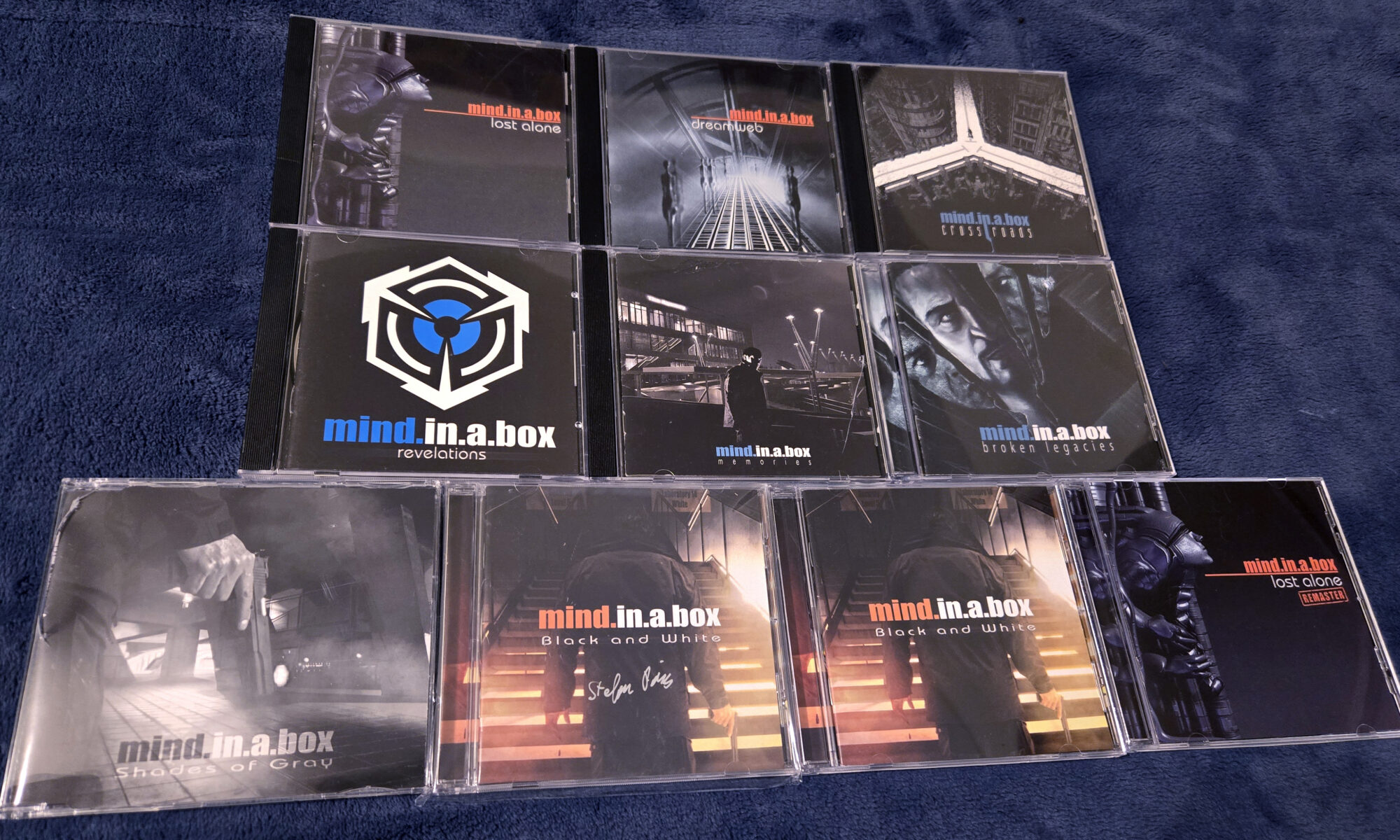
mind.in.a.box album collection

In 2017, shortly before the release of their Broken Legacies album, I realized I had “liked” every mind.in.a.box song that had appeared in my Pandora, Spotify, and YouTube Music playlists over the past several years. I had also begun to wonder what that strange narration was throughout “Into the Night,” my favorite of their songs. Were these audio clips from some movie? Upon looking it up, I was fascinated to discover that “Into the Night” was part of an original, overarching story told through mind.in.a.box’s albums.

I began listening to the albums and loved everything about them, even the tracks representing interludes and narrated story beats. For months, I ritualistically listened to every album every weekend while editing my own novel. In the six years between Broken Legacies and Black and White, I feared I would listen to the albums so much that I would become sick of them. I also feared more music would never come.

Instead, my obsession with mind.in.a.box only grew. I discovered the music producer behind mind.in.a.box Stefan Poiss and his side projects THYX and Loomec. I found remixes and odd songs on compilation albums, singles, and special releases such as “One Day” and the Portal 2 tribute “World without a Sky.” I found mind.in.a.box 2010 live concert tour videos, where songs had been so transformed, it was like hearing them for the first time. I became convinced that everything Stefan Poiss touches is amazing… well, except perhaps “Television Nation.”

That led me to ask myself eight years later in 2025, “Why do I love mind.in.a.box?” It reminded me of a similar question I asked myself in 2013, “Why do I like Final Fantasy VII: Advent Children?” At that time, it had also been my favorite movie for eight years. This question took me six years of study to answer. I analyzed other CGI movies and entire media franchises, wrote articles and produced video analyses of my findings, and finally wrote an examination of Advent Children itself.

Am I embarking on another six-year-long journey? Considering that mind.in.a.box’s first album Lost Alone was an instant success when it was released in 2004, their third album Crossroads has been classified as “one of the greatest futurepop albums of all time,” and they’ve been praised as “one of the most beloved cult bands” in the industrial scene, my love for mind.in.a.box is easy to defend in comparison to a video game-based action movie. Further shrinking the analysis space, while my examination of Advent Children focused on what differentiated it from other CGI movies, I have no such illusions of similarly comparing mind.in.a.box to other music artists. I can pretend to understand filmmaking and storytelling, but I don’t even know what kind of music I listen to, let alone what makes it “good.” Instead, my analysis of mind.in.a.box must focus on its content, its storytelling, and the artists behind it.

To answer the question, “Why do I love mind.in.a.box?” I must also look at myself, for mind.in.a.box’s narrative partly exists in the minds of its listeners. mind.in.a.box combines three of my favorite things: electronic music, unconventional storytelling, and the search for reality.

I’ve been listening to various sub-genres of electronic music since I was nine years old, beginning with the release of Eiffel 65’s Europop. I branched out to Daft Punk, Gabry Ponte, and Bloom 06. I listened to Rammstein and Static-X’s “evil disco.” My cousin introduced me to Orbital, and a high school friend introduced me to Icon of Coil, Combichrist, Juno Reactor, and Covenant. Assemblage 23, Funker Vogt, and Front Line Assembly rose to the top as my favorites for a while. I went through a rough time with Wumpscut, Imperative Reaction, and Suicide Commando in college. Eventually, I landed on VNV Nation, System Syn, and Neuroticfish as favorites. Rotersand, Eisfabrik, and Liquid Divine are among my latest discoveries.

mind.in.a.box has obsessed me unlike any other artist perhaps for their most distinctive characteristic: their approach to vocals. Stefan wasn’t a singer when he and lyricist Markus Hadwiger began mind.in.a.box. While electronic music doesn’t lack for weak singers, Stefan used his voice as a storytelling instrument rather than highlighting his lack of vocal training. By synthesizing his voice with the vocoder, he portrayed different characters, mental states, and levels of communication: dialogue, inner monologues, and subconscious thoughts. Stefan’s confidence and singing ability grew in the two years he spent training his voice, translating his electronic songs to a rock-band setup, and preparing visuals for mind.in.a.box’s first live shows in 2009 and 2010, beginning with the Arvika Festival in Sweden. Vocal effects, however, have remained such an integral part of mind.in.a.box’s sound that the 2012 album Revelations is criticized for its lack of them, instead highlighting Stefan’s honed natural singing voice.

As someone who discovered mind.in.a.box years later, to me, Stefan’s raw voice is as much a part of the band’s sound and storytelling devices as his distorted one. I sometimes think of him as the country singer of futurepop. A man who loses his truck, his wife, and his dog wouldn’t be out of place in a mind.in.a.box song, which frequents the topic of loneliness. The content itself could be what has held my attention so well.

I was introduced to experimental writing in high school with novels like Mark Z. Danielewski’s House of Leaves and Jeff Noon’s epic poem Needle in the Groove. Non-linear writing became the subject of my master’s thesis in college. My study of unconventional CGI movies expanded my appreciation for stories that could only be told in a particular medium. Advent Children‘s rich visuals and minimalistic storytelling couldn’t be presented in any medium other than CGI for example. I’d never heard of a music artist telling a cyberpunk story through their songs and certainly not a band so dedicated to the idea that they told it across seven albums, but it fit naturally into my interest in unconventional storytelling.

Arguably, mind.in.a.box is so intriguing for its unique storytelling method. For most albums and songs, the mind.in.a.box story is subtle and yet significantly adds to the listening experience. A story provides characters for listeners to have experiences and emotions through, another layer of meaning to create deeper connections with listeners, or merely a strange curiosity to grab the listeners’ interest. Some songs only make sense in the context of the rest of the album and the songs surrounding them. Others, even if they mention strange concepts like “Dreamweb,” “Mr. Black,” or “the Agency,” maintain their danceability or emotional relatability to still be enjoyed on their own. Both types of songs encourage listeners to listen to more and listen closer. The band’s story-heavy albums and songs also create a unique, theatrical experience. Black and White in particular is like listening to a futurepop musical.

Finally, mind.in.a.box combines into its narrative the search for truth and reality, which has pervaded my interests since the 2007 release of Zeitgeist: The Movie. This film, my introduction to conspiracy theories, discussed among other topics 9/11 conspiracies, the Federal Reserve, and the dangers of and evidence for a New World Order. Since watching this movie, the idea that the world is not as it seems has themed my interests, my personal life, and my writing. Whether they come from personal experiences or conspiracies, lies, biases, and misconceptions are a treasure trove of ideas to incorporate into fiction.

They’ve also influenced my political beliefs. Initially, I progressed to the sequel Zeitgeist: Addendum (2008), which endorsed a futuristic utopia dreamt by Jacque Fresco and the Venus Project. It was basically communism with computers I eventually decided while exploring the philosophies of Stefan Molyneux, who argued for anarcho-capitalistic societies — government-less with a capitalist economy and ruled by Universally Preferable Behavior. More realistically, through a mix of Jon Stewart, John Oliver, Tim Pool, Steven Crowder, and Sydney Watson, I landed on small-government conservatism, particularly as politics have become more radical. Still, as I’m baffled by those who seem oblivious to how deranged and indoctrinated they sound, I’m haunted by the thought that things are not as they seem.

This uncertainty and the search for reality pervades much of mind.in.a.box’s music. The name “mind.in.a.box” opposes the band’s central theme and goal: to free minds of everything that prevents them from being truly free. While Broken Legacies and Black and White emphasize the dangers of government overreach and propaganda, earlier albums feature more personal messages of how limiting and lonely unrecognized biases, fallacies, and fears can be.

I can explain why I love mind.in.a.box, but I’m also the person who wrote a 30-page, scene-by-scene breakdown of Elysium (2002), a South Korean film few have ever heard of. I’d be remiss if I didn’t also study mind.in.a.box’s lyrics and history and share what else makes this band and the artists behind it brilliant. This will be the subject of future articles. In the meantime, I hope this one gives you a sense of my interpretive lens.

Many reviews praise and critique mind.in.a.box musically, but few focus on analyzing its story. While I don’t have the knowledge to critique mind.in.a.box’s sound, I can say a lot about its storytelling. I’ve been writing and analyzing stories for all the 25+ years I’ve listened to electronic music. I never thought I’d analyze a story told through music, but mind.in.a.box has invited me to step out of my own box.

Perhaps I can encourage you to step out of your box, too. What does mind.in.a.box mean to you?

mind.in.a.box releases a new album Retaliation on September 18, 2026.

You can find Part 2 of this series here.

Furious Alchemists

I’m again a few months late in posting it here, but I made an AMV! An actual AMV, not a video game or CGI-movie “AMV.” It’s my first AMV in a decade in fact!

Teenage me would be so happy to have every episode of Fullmetal Alchemist and Fullmetal Alchemist: Brotherhood at a reasonable video quality, ready for AMV-making. That Emily would be making so many AMVs right now… and they would all be to Static-X and Nine Inch Nails songs. 🙄 I made so many Static-X and Nine Inch Nails AMVs in the mid-2000s…

I’m glad my music tastes moved on. My love for FMA, however, is eternal. To this AMV’s detriment, I can’t get the images from the original FMA out of my head (SO MANY AMVs I’VE MADE!). Despite FMA:B looking prettier and having a modern aspect ratio, I couldn’t leave FMA out of it in honor of my younger self, who would perform human transmutation to have so much FMA footage.

This actually isn’t the AMV I was planning to make, so next year and next OokiiSoraCon, I’ll have another chance to use all this FMA footage. Maybe I’ll even upgrade to modern Adobe Premiere. I realized Adobe Premiere Pro CS5.5 is 15 years old when it dawned on me that its “YouTube HD” rendering setting defaults to an aspect ratio of 1280 x 720. Yes… very HD.

Secret Thoughts

What’s this? A post that isn’t a music video? Madness!

If you want to see more of my thoughts more often, I’ve started a personal blog called Secret Thoughts. It will mostly be mini reviews of what I’m reading, watching, and listening to, but there are other random musings, too. If you have no interest in my secret thoughts, I’m working on a couple other writing projects I hope to release in the coming weeks and months as well.

Common People Like Cloud

It’s been a few months, but at the end of the July, my latest AMV won Best Action and Best of Show at OokiiSoraCon.

I’ve dreamt about winning an AMV contest for more than a decade. Even though OokiiSoraCon’s AMV+ contest is tiny, I’m still happy. 😀

Daft Punk’s Sorrows

Hey! It’s my second music video in four years! Although, this one is a remake of a music video I made… 14 years ago. O.o

Among other things, I upgraded from crappy, timecode-stamped footage to glorious DVD quality. I’ve meant to remake this video for 11 years (yes, that is how old the project file is on my computer). When I finally decided to do it in June, I thought maybe I’d waited and procrastinated long enough for Daft Punk to have re-released Electroma in HD, but sadly, no. There may never be sad robots in HD.

I also made this music video for OokiiSoraCon’s AMV+ contest. It also didn’t win me any prizes. Sad.

Cheeky Geeky Vaudeville: Hindsight is 20/20 and Other News

The Cheeky Geeky Vaudeville: Hindsight is 20/20 Show came out on Halloween. I’m behind with posting it, but well, the past four months have been strange, terrible, exciting, and fast-paced. Among other things, a traumatic death occurred in my family. Then, I got a full-time job as a Software Engineer and moved to another state. Three big life events in four months is a lot but typical 2020 chaos I suppose. Anyway, here’s Cheeky Geeky Vaudeville’s annual fall performance, presented digitally at a safe social distance.