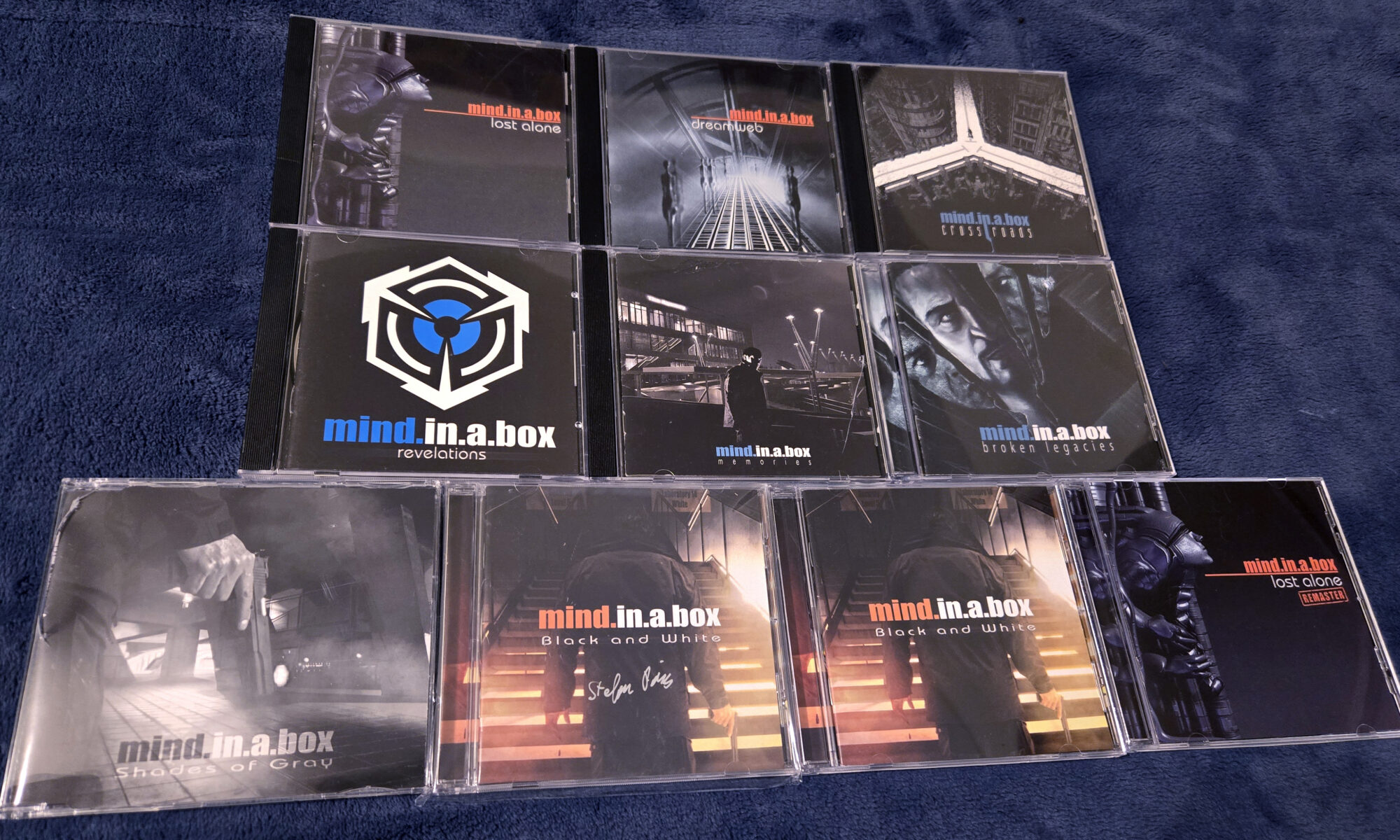
In 2017, shortly before the release of their Broken Legacies album, I realized I had “liked” every mind.in.a.box song that had appeared in my Pandora, Spotify, and YouTube Music playlists over the past several years. I had also begun to wonder what that strange narration was throughout “Into the Night,” my favorite of their songs. Were these audio clips from some movie? Upon looking it up, I was fascinated to discover that “Into the Night” was part of an original, overarching story told through mind.in.a.box’s albums.
I began listening to the albums and loved everything about them, even the tracks representing interludes and narrated story beats. For months, I ritualistically listened to every album every weekend while editing my own novel. In the six years between Broken Legacies and Black and White, I feared I would listen to the albums so much that I would become sick of them. I also feared more music would never come.
Instead, my obsession with mind.in.a.box only grew. I discovered the music producer behind mind.in.a.box Stefan Poiss and his side projects THYX and Loomec. I found remixes and odd songs on compilation albums, singles, and special releases such as “One Day” and the Portal 2 tribute “World without a Sky.” I found mind.in.a.box 2010 live concert tour videos, where songs had been so transformed, it was like hearing them for the first time. I became convinced that everything Stefan Poiss touches is amazing… well, except perhaps “Television Nation.”
That led me to ask myself eight years later in 2025, “Why do I love mind.in.a.box?” It reminded me of a similar question I asked myself in 2013, “Why do I like Final Fantasy VII: Advent Children?” At that time, it had also been my favorite movie for eight years. This question took me six years of study to answer. I analyzed other CGI movies and entire media franchises, wrote articles and produced video analyses of my findings, and finally wrote an examination of Advent Children itself.
Am I embarking on another six-year-long journey? Considering that mind.in.a.box’s first album Lost Alone was an instant success when it was released in 2004, their third album Crossroads has been classified as “one of the greatest futurepop albums of all time,” and they’ve been praised as “one of the most beloved cult bands” in the industrial scene, my love for mind.in.a.box is easy to defend in comparison to a video game-based action movie. Further shrinking the analysis space, while my examination of Advent Children focused on what differentiated it from other CGI movies, I have no such illusions of similarly comparing mind.in.a.box to other music artists. I can pretend to understand filmmaking and storytelling, but I don’t even know what kind of music I listen to, let alone what makes it “good.” Instead, my analysis of mind.in.a.box must focus on its content, its storytelling, and the artists behind it.
To answer the question, “Why do I love mind.in.a.box?” I must also look at myself, for mind.in.a.box’s narrative partly exists in the minds of its listeners. mind.in.a.box combines three of my favorite things: electronic music, unconventional storytelling, and the search for reality.
I’ve been listening to various sub-genres of electronic music since I was nine years old, beginning with the release of Eiffel 65’s Europop. I branched out to Daft Punk, Gabry Ponte, and Bloom 06. I listened to Rammstein and Static-X’s “evil disco.” My cousin introduced me to Orbital, and a high school friend introduced me to Icon of Coil, Combichrist, Juno Reactor, and Covenant. Assemblage 23, Funker Vogt, and Front Line Assembly rose to the top as my favorites for a while. I went through a rough time with Wumpscut, Imperative Reaction, and Suicide Commando in college. Eventually, I landed on VNV Nation, System Syn, and Neuroticfish as favorites. Rotersand, Eisfabrik, and Liquid Divine are among my latest discoveries.
mind.in.a.box has obsessed me unlike any other artist perhaps for their most distinctive characteristic: their approach to vocals. Stefan wasn’t a singer when he and lyricist Markus Hadwiger began mind.in.a.box. While electronic music doesn’t lack for weak singers, Stefan used his voice as a storytelling instrument rather than highlighting his lack of vocal training. By synthesizing his voice with the vocoder, he portrayed different characters, mental states, and levels of communication: dialogue, inner monologues, and subconscious thoughts. Stefan’s confidence and singing ability grew in the two years he spent training his voice, translating his electronic songs to a rock-band setup, and preparing visuals for mind.in.a.box’s first live shows in 2009 and 2010, beginning with the Arvika Festival in Sweden. Vocal effects, however, have remained such an integral part of mind.in.a.box’s sound that the 2012 album Revelations is criticized for its lack of them, instead highlighting Stefan’s honed natural singing voice.
As someone who discovered mind.in.a.box years later, to me, Stefan’s raw voice is as much a part of the band’s sound and storytelling devices as his distorted one. I sometimes think of him as the country singer of futurepop. A man who loses his truck, his wife, and his dog wouldn’t be out of place in a mind.in.a.box song, which frequents the topic of loneliness. The content itself could be what has held my attention so well.
I was introduced to experimental writing in high school with novels like Mark Z. Danielewski’s House of Leaves and Jeff Noon’s epic poem Needle in the Groove. Non-linear writing became the subject of my master’s thesis in college. My study of unconventional CGI movies expanded my appreciation for stories that could only be told in a particular medium. Advent Children‘s rich visuals and minimalistic storytelling couldn’t be presented in any medium other than CGI for example. I’d never heard of a music artist telling a cyberpunk story through their songs and certainly not a band so dedicated to the idea that they told it across seven albums, but it fit naturally into my interest in unconventional storytelling.
Arguably, mind.in.a.box is so intriguing for its unique storytelling method. For most albums and songs, the mind.in.a.box story is subtle and yet significantly adds to the listening experience. A story provides characters for listeners to have experiences and emotions through, another layer of meaning to create deeper connections with listeners, or merely a strange curiosity to grab the listeners’ interest. Some songs only make sense in the context of the rest of the album and the songs surrounding them. Others, even if they mention strange concepts like “Dreamweb,” “Mr. Black,” or “the Agency,” maintain their danceability or emotional relatability to still be enjoyed on their own. Both types of songs encourage listeners to listen to more and listen closer. The band’s story-heavy albums and songs also create a unique, theatrical experience. Black and White in particular is like listening to a futurepop musical.
Finally, mind.in.a.box combines into its narrative the search for truth and reality, which has pervaded my interests since the 2007 release of Zeitgeist: The Movie. This film, my introduction to conspiracy theories, discussed among other topics 9/11 conspiracies, the Federal Reserve, and the dangers of and evidence for a New World Order. Since watching this movie, the idea that the world is not as it seems has themed my interests, my personal life, and my writing. Whether they come from personal experiences or conspiracies, lies, biases, and misconceptions are a treasure trove of ideas to incorporate into fiction.
They’ve also influenced my political beliefs. Initially, I progressed to the sequel Zeitgeist: Addendum (2008), which endorsed a futuristic utopia dreamt by Jacque Fresco and the Venus Project. It was basically communism with computers I eventually decided while exploring the philosophies of Stefan Molyneux, who argued for anarcho-capitalistic societies — government-less with a capitalist economy and ruled by Universally Preferable Behavior. More realistically, through a mix of Jon Stewart, John Oliver, Tim Pool, Steven Crowder, and Sydney Watson, I landed on small-government conservatism, particularly as politics have become more radical. Still, as I’m baffled by those who seem oblivious to how deranged and indoctrinated they sound, I’m haunted by the thought that things are not as they seem.
This uncertainty and the search for reality pervades much of mind.in.a.box’s music. The name “mind.in.a.box” opposes the band’s central theme and goal: to free minds of everything that prevents them from being truly free. While Broken Legacies and Black and White emphasize the dangers of government overreach and propaganda, earlier albums feature more personal messages of how limiting and lonely unrecognized biases, fallacies, and fears can be.
I can explain why I love mind.in.a.box, but I’m also the person who wrote a 30-page, scene-by-scene breakdown of Elysium (2002), a South Korean film few have ever heard of. I’d be remiss if I didn’t also study mind.in.a.box’s lyrics and history and share what else makes this band and the artists behind it brilliant. This will be the subject of future articles. In the meantime, I hope this one gives you a sense of my interpretive lens.
Many reviews praise and critique mind.in.a.box musically, but few focus on analyzing its story. While I don’t have the knowledge to critique mind.in.a.box’s sound, I can say a lot about its storytelling. I’ve been writing and analyzing stories for all the 25+ years I’ve listened to electronic music. I never thought I’d analyze a story told through music, but mind.in.a.box has invited me to step out of my own box.
Perhaps I can encourage you to step out of your box, too. What does mind.in.a.box mean to you?
One Reply to “Why do I love mind.in.a.box?”