mind.in.a.box: Crossroads is not about amnesia

Crossroads is not about amnesia header image

mind.in.a.box’s third album Crossroads is about amnesia. The second song is titled “Amnesia.” The short story included in the lyric book reveals the protagonist Black’s memory was wiped between the previous album and Crossroads. In the opening song, Black tells the listener his former boss White “tried to erase my identity.” The band’s official story synopsis, interviews, and many reviews of Crossroads include a remark that this chapter of mind.in.a.box’s science fiction saga is about Black’s amnesia.

Crossroads was the first of mind.in.a.box’s concept albums to include a supplementary short story, and its clarity in comparison to Markus Hadwiger’s esoteric lyrics suggests Black’s amnesia is a fact closed to interpretation. In an interview with I Die You Die, however, mind.in.a.box’s producer Stefan Poiss suggests German science fiction author Andreas Gruber wrote the short story while listening to the completed album. That is, the short story was only an interpretation of Hadwiger’s lyrics and Poiss’ music, not canon at the time. It inspires the listener to seek the story told in the album’s content, but that story doesn’t have to be the one Gruber found.

When analyzed without the supplementary short story, Crossroads doesn’t have to be about amnesia, at least not about any of the events that have transpired since the first album Lost Alone. Instead, it continues a realization Black has from the second album Dreamweb: he is a pawn who discarded his identity long before the albums’ events began.

Evidence for this conclusion begins with mind.in.a.box’s first chapter Lost Alone. This album contains two “story songs”: “Waiting” and “Forever Gone.” Underplayed by atmospheric electronic music, these songs feature a nameless agent reporting his activities in tracking a “he” and “she.” Crossroads names the agent Black and the fifth album Memories formally links the “he” to The Friend and “she” to Night, character names which also begin appearing in Crossroads. For simplicity, I’ll refer to these characters using these names.

These story songs invite the listener to interpret the rest of the album through the perspective of these three characters. Poiss’ vocals and use of vocal effects to portray characters, mental or physical states, dialogue, inner monologues, and subconscious thoughts supports multiple interpretations. One reviewer can interpret all the songs from Black’s perspective. Another can assert only the story songs are part of the storyline and the remaining songs, while fitting the theme, are unrelated. “Walking” can be interpreted as Black’s subconscious thoughts or The Friend’s conscious ones, and “Lost Alone” implies multiple miserable narrators exist, unaware they are lost alone together.

You are not the only one,
Lost alone in this world.
There are others beside you,
Feeling empty and hurt
Feeling empty and hurt.

For me, The Friend is the primary narrator of Lost Alone but, crucially, not the only one. Sung in Poiss’ natural singing voice, the fourth song “You Will See” describes The Friend’s fall from a position of power, causing his partner Night to abandon him. Angered by her shallowness, The Friend vows to return to his place of prominence, but she will never be a part of his life again.

Reviewers often interpret Poiss’ distorted vocals in the second song “Change” as feminine. With this in mind, “Change” depicts Night’s perspective of the relationship’s end. Her reason for ending it has little to do with The Friend’s former position. Rather, it stems from a fear of closeness and the change it brings, fears she misinterprets as selfishness.

I do not need anybody else,
Bonds would put my mind into cells.


I am the one who cries out at night,
For somebody to change my very core.
Not sure why I live in endless fright,
Doomed to love only myself for evermore.

Supporting this interpretation, the opening song “Light & Dark” features two characters, one represented by Poiss’ natural singing voice and the other by feminine vocals, repeating the same lonely refrain.

I feel sad, so left alone.
Words are not enough,
For me to live on.

This and the rest of the album illustrates how the two characters really feel. Despite his spiteful words in “You Will See,” The Friend “Questions” his decisions and becomes so lost in heartbreak that he doesn’t notice Black has placed a trace on him. Black notes this in “Waiting” and also reveals “he is looking for her. We thought he doesn’t know, but now he seems really desperate to find her.” The Friend has determined to reunite with Night it seems, but she has become difficult to reach. She’s escaped to what Black calls “the other side,” the Dreamweb as named in future albums. Black and his nefarious employer pursue The Friend in his desperate quest either to allow him to unwittingly lead them to the Dreamweb or to prevent him from becoming another escapee. Ultimately, in his effort to elude Black and reach Night, The Friend commits suicide, or that’s how it looks from Black’s perspective.

Somebody must have tipped him off.

His body. It was sprawled on the floor.

Either he is dead, or he has switched over.

Unknown to Black, The Friend has escaped the physical world entirely into the Dreamweb as suggested by the taunting lyrics interspersed with Black’s report in “Forever Gone” and by the hopeful lyrics of “Lost Alone 2.” Whether The Friend found Night on the other side or not, he doesn’t feel alone anymore.

Your mind the beacon that guides me,
When I’m lost I know I will find you.
Through the fire that consumes me,
You will know that I’m lost alone too.

The most important song on the album in relation to this analysis, however, is the final song “Leave.” Interpreted from The Friend’s perspective, it doesn’t make sense after the optimism of “Lost Alone 2.” Echoing “Questions,” “Leave” portrays restlessness and confusion.

This is not what I had wanted,
I have to leave this place
This is not what I had dreamed of,
I need to gain more space.

“Tape Evidence,” the opening of the second album Dreamweb, contains strong evidence that “Leave” is Black’s perspective. Although no longer tinny as if spoken through a phone, “Tape Evidence” features mostly spoken words rather than sung lyrics like Black’s reports. This suggests it’s Black complaining his dreams are restless. Interspersed with his narration are snippets from Lost Alone and Dreamweb. Immediately after Black says, “There were many things from my past,” is a clip from “Leave.” When interpreted as Black’s past and therefore his perspective, “Leave” implies he found The Friend’s apparent suicide deeply disturbing.

Besides “Tape Evidence,” Dreamweb provides two story songs for listeners to use as a lens to interpret the rest of the album. In the tenth song “Reflections” Black recounts what has occurred since The Friend “disappeared eight months ago.” Black’s employer White learns through an informant when Night will be at a club. In the eighth song “Dead End,” Black infiltrates the club but falls unconscious under the strange effect of the club’s music while pursuing her. When he awakens, he sees White attaining a tape from someone and leaving Black in the gutter. Black returns home, but the music remains stuck in his head. Then, in the opening song “Tape Evidence,” someone leaves a tape on his doorstep.

The reverse ordering and overlapping of these story beats not only gives context to the other songs but also encourages listeners to consider that the rest of the album isn’t in order either. Additionally, while some songs can be interpreted from The Friend’s perspective, Black becomes the dominant voice as he ponders his failure to attain the secrets of the Dreamweb.

Dreamweb is a character study analyzing what Black found so disturbing about The Friend’s death. Future albums elaborate that Black is an Agent working for an all-powerful, all-controlling Agency. The Dreamweb represents a place beyond the Agency’s control where minds may freely pursue their dreams, a synonym for goals or aspirations. In this way, the Dreamweb album uses the pursuit of the Dreamweb nearly synonymously with the pursuit of one’s dreams, particularly for Black. “Lament for Lost Dreams” reveals Black once had dreams, but unlike The Friend who was so devoted to his dreams that he left the physical world, Black abandoned his.

I cried for what was not meant to be,
A last tribute to lost dreams.


I will thrust my agony aside,
To prepare for a new day.

Black doesn’t say what his dreams were or why he felt he couldn’t reach them, but the following song “Machine Run” suggests that to escape the pain of losing these dreams, he devoted himself to the Agency.

Driven by the need to forget,
You had lost all your dreams.
Running from your pain and regret,
You wanted to escape their web.

“Sun and Storm” suggests that pursuing The Friend filled a void that Black’s employment could not. When The Friend vanished, taking all clues to the Dreamweb with him, Black became aware that the lost dreams he thought he was running from were also the ones he was pursuing. The Friend casts sunlight upon Black’s unhappiness but also a storm of uncertainty as to his identity as an Agent.

You had come to fill the void,
But you always were forlorn.
You had come into my life,
And you brought both sun and storm.


When you fell I had to stay,
But I think I’ve also died.

External forces also fuel Black’s uncertainty. In “Tape Evidence,” Black says, “I can feel them, in my head.” By some interpretations, “them” could be The Friend, Night, or the escapees they represent, what Crossroads calls the Sleepwalkers. Interpreted from The Friend’s perspective, “Out of Time’s” agitation suggests The Friend isn’t content with leaving behind those like Black who are unable to reach the Dreamweb.

No one feels his infiltration,
Always repenting of his crime.
Still stained with desecration,
Forever floating out of time

When he falls unconscious under the Sleepwalkers’ influence in “Dead End,” Black experiences “The Dream” in which The Friend infiltrates his mind.

You fell asleep and now you’re mine.
I feel so helpless and so weak.
Just let go and embrace your dream.
I’ve lost track of what I am.

“The Dream,” however, is also benevolent. Black begins the song lost in his hopeless search. The deep voice invading his mind then tells him truths about his life, and by the end, Black realizes this dream is his. He has attained access to the Dreamweb.

“Them” could also refer to White and the Agency, which only become more sinister as the album progresses. In “Reflections,” Black feels confused and betrayed by White’s assured presence at the club. When “You fell asleep and now you’re mine” in “The Dream” is reinterpreted as the words of White, Black’s experience at the club feels more like a setup.

Sensing Black’s uncertainty, his empathy for The Friend, and knowing of his lost dreams, White surmises that given the opportunity, Black may attempt to escape into the Dreamweb. He sends Black to the club to allow it to happen, which it does in “The Dream.” Unlike The Friend and Night who have evaded him, White is prepared for Black. He monitors Black’s entrance into the Dreamweb and then forces him to return. The tape represents the knowledge White gains from observing Black. No longer of use to him, White leaves Black in the gutter.

Several songs throughout the album support this interpretation. “Between Worlds” relays Black’s disorientation with returning to reality. Given a glimpse of the Dreamweb, rejected from his life as an Agent, and unable to return to the lost dreams of his past, Black feels “suspended between worlds.” He didn’t expect to return to reality either.

You thought you would not waken,
So what did go wrong?

In “Loyalty,” Black accuses White of stealing his dreams. Black thought he was pursuing the Dreamweb for the Agency, but it was his own dreams that he had never stopped pursuing. The unconscious desires he thought he had abandoned were exploited for the Agency’s gain.

You made me feel needed.
You could see my soul.
I gave you my loyalty.
You chose to make me fall.

Reinterpreted from White’s perspective, “Out of Time” depicts White as the covert influencer. It points out his crime in betraying Black, but also hints at his own personal reasons for pursuing the Dreamweb so relentlessly, reasons explored further in future albums.

Where will you find your soul?
When will you find your peace?

The second song of the album “Certainty” tells listeners Black is uncertain, but it’s the rest of the album that explores all the reasons he has for his uncertainty. The exchange of harsh frustrations and pleas for reassurance within “Certainty” could depict Black arguing internally with himself or Black arguing aloud with White. His need for reassurance could either be directed at The Friend after his apparent death or White after his betrayal.

It hurts more than anything,
My world now turns to ashes.
Your silence so demeaning,
My heart falters in flashes.

Seeing a potential ally in Black, the Sleepwalkers ensure he also receives the tape. Until they find Night, however, Black and White can still only speculate how the music opened the Dreamweb’s door.

Here the events of Crossroads begin. In the opening track “Introspection,” Black dreams he awakens in a glass tank of water. Night and The Friend watch him from the outside. This track names them for the first time but doesn’t clearly trace them to the “he” and “she” they’ve been referred to as until now. For now, they merely represent a benevolent force that have allowed Black to see the glass walls that have encased his life. Then, the glass shatters, freeing him to see the reality: White tried to erase his identity.

This opening track and the following track “Amnesia” create the impression that Black has forgotten all the events that have transpired. Simultaneously, they both hint he hasn’t.

I feel like I have amnesia,
but I know it’s myself I’ve lost.


I’m surprised I’ve come this far,
Living without what I need most.

These lyrics from “Amnesia” outright say Black doesn’t have amnesia. What he has lost is the identity defined by the dreams he once had, which the previous album already established. In the following song “Into the Night,” Black revisits locations from Lost Alone and Dreamweb but not because he can’t remember what happened there. He seeks to understand what gave him a glimpse of the Dreamweb and how he can access it again.

So you remember the night when I was following that girl?
What happened that night?


Sleepwalkers? Never heard… What are they?

Like the first song of Dreamweb, “Introspection” can be thought of as a recap of the previous albums and a preview of what’s to come. Black says:

I awoke in an empty flat that told me nothing.
And I knew that I had to get away.
White had tried to erase my identity,
But the Sleepwalkers had saved my mind.

Everything Black has and is was given to him by the Agency, so his flat would contain nothing personal to him, nothing that reminds him of who he was. White sought to turn Black into a thoughtless servant to the Agency’s goals and poacher of other people’s dreams, but Black’s encounter with The Friend awoke him to the lost dreams White was using against him.

While “Machine Run” from Dreamweb depicts Black abandoning his past identity, “Stalkers” from Crossroads adds that the Agency’s hive-mind-like collective of Agents contributed to Black’s erasure. Underplayed by a relentless march, “Stalkers” alternates between a drone of voices and the distorted vocals of a mind being erased.

We know we serve someone else.
We have swallowed our pride.
We march to this tune of loss.
We take this in our stride.


I can feel my thoughts dying out,
So my last thought is just your name.
And it is all that will remain.

In “Identity,” Black describes the contentedness felt despite his awareness that he’d been absorbed into a collective, but now he has resolved to find himself again. Still, obstacles make him hesitant. “Fear” contains general themes related to imposter syndrome and willful blindness. Imposters portray a certain persona, but internally, they believe they are fake and fear being discovered. The blind believe they are a certain type of person, but in reality, they fear recognizing their own flaws or hypocrisy. In the context of Black’s story, Black fears who he used to be, someone so flawed that he sacrificed his dreams to the nefarious Agency.

You have learned how to deceive,
And yourself is all you can hear.
You think you really believe,
But deep down you are only fear.

In “What Used to Be,” Black reaches the conclusion that it’s not too late to atone. The resolution to Crossroads culminates in “The Place” where Black accepts his old identity as lost. No matter where he goes from here, he will still be himself, reminiscent of a philosophical and psychological concept that the only constant in life is that you, the observer, are the one experiencing it. Identity, dreams, purpose, personality, all else is subject to change. In the previous two albums, Black hints that he has lost dreams, and in Crossroads, he reveals that he doesn’t know what they are either. He isn’t that person anymore, but that doesn’t mean he can’t follow a new dream.

And whoever I was, it doesn’t matter anymore I know.
All these memories hidden deep down below.
Though somewhere on the way before, all those things got lost,
I know there will be new things wherever I may go.

If I sound like I’m rejecting the most obvious interpretation of Crossroads for the sake of argument, other reviewers have reached a similar conclusion: Crossroads is about loss of identity. Black’s story certainly has elements of memory loss, but identity loss is the more relatable experience, adding to its credibility as Crossroads’ central event and theme. Listeners are more likely to have had experiences that led them to reevaluate how they see themselves and their place in the world than they are to have experienced amnesia. Regardless, Crossroads and prior albums are composed to support multiple interpretations. Markus Hadwiger and Stefan Poiss intended for their music to have multiple meanings. Perhaps that’s why their music is so enduring. Finding meaning and making connections between albums, songs, and ideas is like finding all the solutions to a puzzle, even when it gives the impression that there is only one.
mind.in.a.box releases a new album Retaliation on September 18, 2026.

You can find Part 3 of this series here.

Why do I love mind.in.a.box?

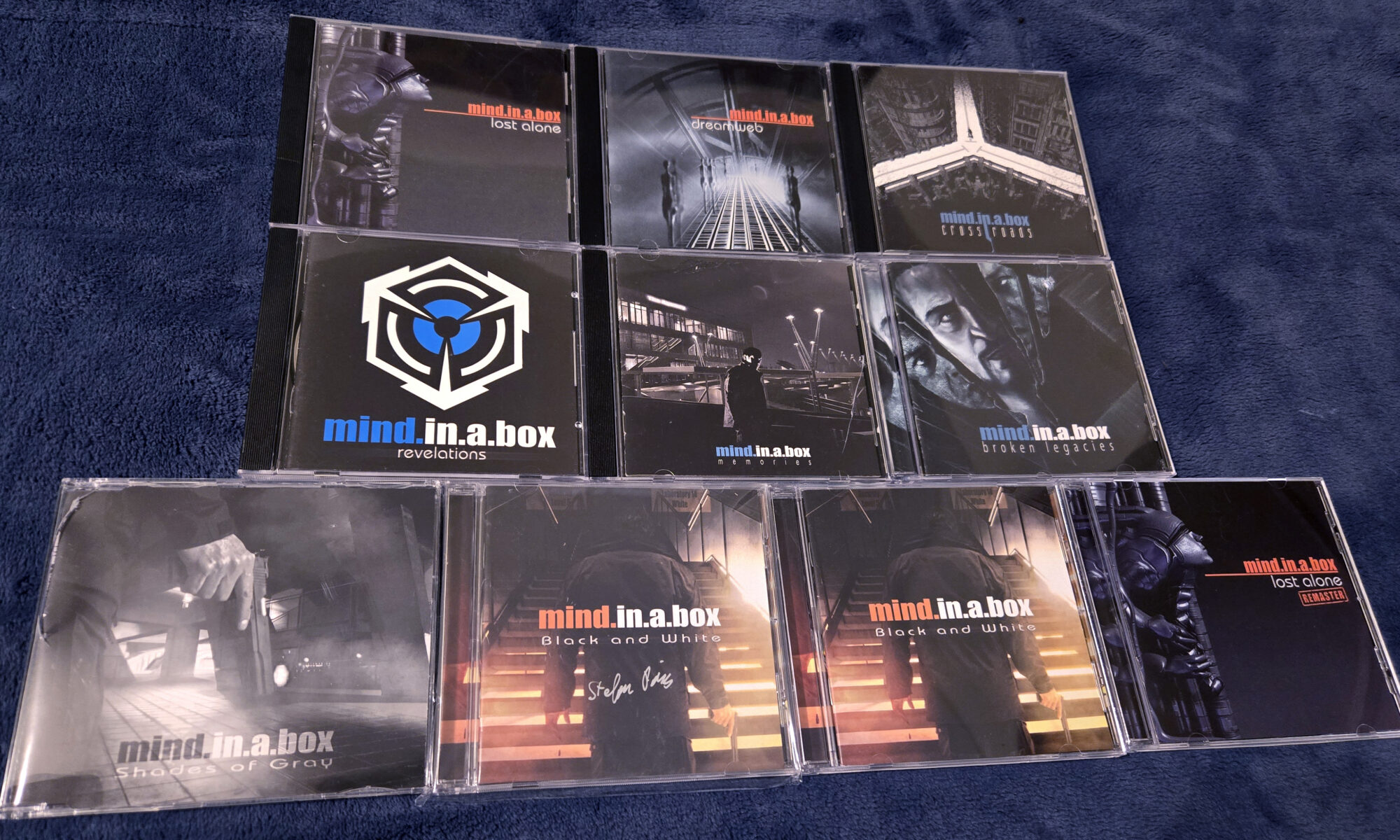
mind.in.a.box album collection

In 2017, shortly before the release of their Broken Legacies album, I realized I had “liked” every mind.in.a.box song that had appeared in my Pandora, Spotify, and YouTube Music playlists over the past several years. I had also begun to wonder what that strange narration was throughout “Into the Night,” my favorite of their songs. Were these audio clips from some movie? Upon looking it up, I was fascinated to discover that “Into the Night” was part of an original, overarching story told through mind.in.a.box’s albums.

I began listening to the albums and loved everything about them, even the tracks representing interludes and narrated story beats. For months, I ritualistically listened to every album every weekend while editing my own novel. In the six years between Broken Legacies and Black and White, I feared I would listen to the albums so much that I would become sick of them. I also feared more music would never come.

Instead, my obsession with mind.in.a.box only grew. I discovered the music producer behind mind.in.a.box Stefan Poiss and his side projects THYX and Loomec. I found remixes and odd songs on compilation albums, singles, and special releases such as “One Day” and the Portal 2 tribute “World without a Sky.” I found mind.in.a.box 2010 live concert tour videos, where songs had been so transformed, it was like hearing them for the first time. I became convinced that everything Stefan Poiss touches is amazing… well, except perhaps “Television Nation.”

That led me to ask myself eight years later in 2025, “Why do I love mind.in.a.box?” It reminded me of a similar question I asked myself in 2013, “Why do I like Final Fantasy VII: Advent Children?” At that time, it had also been my favorite movie for eight years. This question took me six years of study to answer. I analyzed other CGI movies and entire media franchises, wrote articles and produced video analyses of my findings, and finally wrote an examination of Advent Children itself.

Am I embarking on another six-year-long journey? Considering that mind.in.a.box’s first album Lost Alone was an instant success when it was released in 2004, their third album Crossroads has been classified as “one of the greatest futurepop albums of all time,” and they’ve been praised as “one of the most beloved cult bands” in the industrial scene, my love for mind.in.a.box is easy to defend in comparison to a video game-based action movie. Further shrinking the analysis space, while my examination of Advent Children focused on what differentiated it from other CGI movies, I have no such illusions of similarly comparing mind.in.a.box to other music artists. I can pretend to understand filmmaking and storytelling, but I don’t even know what kind of music I listen to, let alone what makes it “good.” Instead, my analysis of mind.in.a.box must focus on its content, its storytelling, and the artists behind it.

To answer the question, “Why do I love mind.in.a.box?” I must also look at myself, for mind.in.a.box’s narrative partly exists in the minds of its listeners. mind.in.a.box combines three of my favorite things: electronic music, unconventional storytelling, and the search for reality.

I’ve been listening to various sub-genres of electronic music since I was nine years old, beginning with the release of Eiffel 65’s Europop. I branched out to Daft Punk, Gabry Ponte, and Bloom 06. I listened to Rammstein and Static-X’s “evil disco.” My cousin introduced me to Orbital, and a high school friend introduced me to Icon of Coil, Combichrist, Juno Reactor, and Covenant. Assemblage 23, Funker Vogt, and Front Line Assembly rose to the top as my favorites for a while. I went through a rough time with Wumpscut, Imperative Reaction, and Suicide Commando in college. Eventually, I landed on VNV Nation, System Syn, and Neuroticfish as favorites. Rotersand, Eisfabrik, and Liquid Divine are among my latest discoveries.

mind.in.a.box has obsessed me unlike any other artist perhaps for their most distinctive characteristic: their approach to vocals. Stefan wasn’t a singer when he and lyricist Markus Hadwiger began mind.in.a.box. While electronic music doesn’t lack for weak singers, Stefan used his voice as a storytelling instrument rather than highlighting his lack of vocal training. By synthesizing his voice with the vocoder, he portrayed different characters, mental states, and levels of communication: dialogue, inner monologues, and subconscious thoughts. Stefan’s confidence and singing ability grew in the two years he spent training his voice, translating his electronic songs to a rock-band setup, and preparing visuals for mind.in.a.box’s first live shows in 2009 and 2010, beginning with the Arvika Festival in Sweden. Vocal effects, however, have remained such an integral part of mind.in.a.box’s sound that the 2012 album Revelations is criticized for its lack of them, instead highlighting Stefan’s honed natural singing voice.

As someone who discovered mind.in.a.box years later, to me, Stefan’s raw voice is as much a part of the band’s sound and storytelling devices as his distorted one. I sometimes think of him as the country singer of futurepop. A man who loses his truck, his wife, and his dog wouldn’t be out of place in a mind.in.a.box song, which frequents the topic of loneliness. The content itself could be what has held my attention so well.

I was introduced to experimental writing in high school with novels like Mark Z. Danielewski’s House of Leaves and Jeff Noon’s epic poem Needle in the Groove. Non-linear writing became the subject of my master’s thesis in college. My study of unconventional CGI movies expanded my appreciation for stories that could only be told in a particular medium. Advent Children‘s rich visuals and minimalistic storytelling couldn’t be presented in any medium other than CGI for example. I’d never heard of a music artist telling a cyberpunk story through their songs and certainly not a band so dedicated to the idea that they told it across seven albums, but it fit naturally into my interest in unconventional storytelling.

Arguably, mind.in.a.box is so intriguing for its unique storytelling method. For most albums and songs, the mind.in.a.box story is subtle and yet significantly adds to the listening experience. A story provides characters for listeners to have experiences and emotions through, another layer of meaning to create deeper connections with listeners, or merely a strange curiosity to grab the listeners’ interest. Some songs only make sense in the context of the rest of the album and the songs surrounding them. Others, even if they mention strange concepts like “Dreamweb,” “Mr. Black,” or “the Agency,” maintain their danceability or emotional relatability to still be enjoyed on their own. Both types of songs encourage listeners to listen to more and listen closer. The band’s story-heavy albums and songs also create a unique, theatrical experience. Black and White in particular is like listening to a futurepop musical.

Finally, mind.in.a.box combines into its narrative the search for truth and reality, which has pervaded my interests since the 2007 release of Zeitgeist: The Movie. This film, my introduction to conspiracy theories, discussed among other topics 9/11 conspiracies, the Federal Reserve, and the dangers of and evidence for a New World Order. Since watching this movie, the idea that the world is not as it seems has themed my interests, my personal life, and my writing. Whether they come from personal experiences or conspiracies, lies, biases, and misconceptions are a treasure trove of ideas to incorporate into fiction.

They’ve also influenced my political beliefs. Initially, I progressed to the sequel Zeitgeist: Addendum (2008), which endorsed a futuristic utopia dreamt by Jacque Fresco and the Venus Project. It was basically communism with computers I eventually decided while exploring the philosophies of Stefan Molyneux, who argued for anarcho-capitalistic societies — government-less with a capitalist economy and ruled by Universally Preferable Behavior. More realistically, through a mix of Jon Stewart, John Oliver, Tim Pool, Steven Crowder, and Sydney Watson, I landed on small-government conservatism, particularly as politics have become more radical. Still, as I’m baffled by those who seem oblivious to how deranged and indoctrinated they sound, I’m haunted by the thought that things are not as they seem.

This uncertainty and the search for reality pervades much of mind.in.a.box’s music. The name “mind.in.a.box” opposes the band’s central theme and goal: to free minds of everything that prevents them from being truly free. While Broken Legacies and Black and White emphasize the dangers of government overreach and propaganda, earlier albums feature more personal messages of how limiting and lonely unrecognized biases, fallacies, and fears can be.

I can explain why I love mind.in.a.box, but I’m also the person who wrote a 30-page, scene-by-scene breakdown of Elysium (2002), a South Korean film few have ever heard of. I’d be remiss if I didn’t also study mind.in.a.box’s lyrics and history and share what else makes this band and the artists behind it brilliant. This will be the subject of future articles. In the meantime, I hope this one gives you a sense of my interpretive lens.

Many reviews praise and critique mind.in.a.box musically, but few focus on analyzing its story. While I don’t have the knowledge to critique mind.in.a.box’s sound, I can say a lot about its storytelling. I’ve been writing and analyzing stories for all the 25+ years I’ve listened to electronic music. I never thought I’d analyze a story told through music, but mind.in.a.box has invited me to step out of my own box.

Perhaps I can encourage you to step out of your box, too. What does mind.in.a.box mean to you?

mind.in.a.box releases a new album Retaliation on September 18, 2026.

You can find Part 2 of this series here.

Secret Thoughts

What’s this? A post that isn’t a music video? Madness!

If you want to see more of my thoughts more often, I’ve started a personal blog called Secret Thoughts. It will mostly be mini reviews of what I’m reading, watching, and listening to, but there are other random musings, too. If you have no interest in my secret thoughts, I’m working on a couple other writing projects I hope to release in the coming weeks and months as well.

Final Fantasy XV: The Void Noctis Continued to Leave Behind

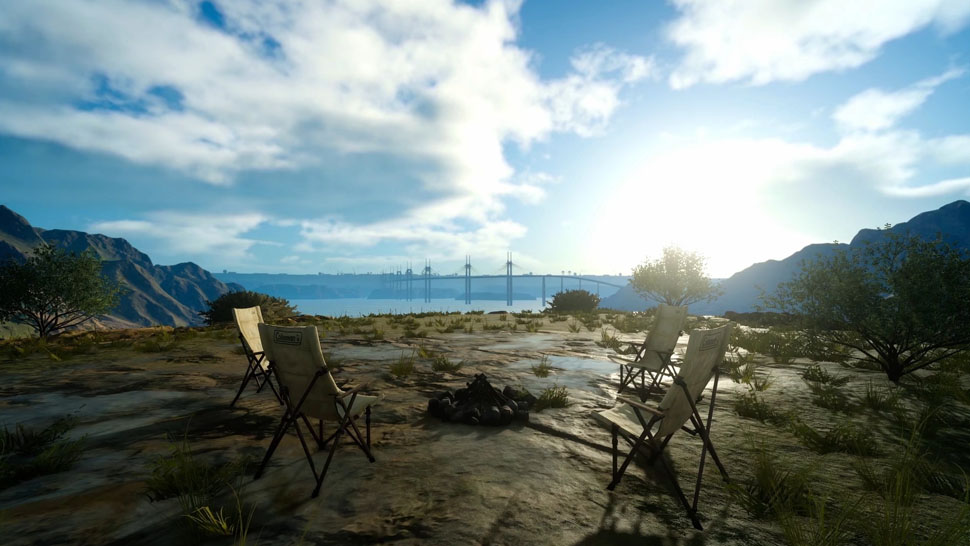
Empty Coleman Chairs

Originally published on the Extra Life Community website
Edited by Jack Gardner

“Listen to my story.” Tidus, the protagonist of Final Fantasy X, opens the game with this line, and his voice carries its compelling tale to a thrilling conclusion. Fifteen years later, Square Enix released Final Fantasy XV and bet its protagonist Prince Noctis had a voice strong enough to carry a media franchise. The movie Kingsglaive showed Noctis’ home. The anime series Brotherhood introduced Noctis’ friends. The Omen trailer revealed Noctis’ worst nightmare. Final Fantasy XV would tell Noctis’ story… or would it?

Beware: this in-depth analysis of Final Fantasy XV contains spoilers.

Like how Tidus propels Final Fantasy X’s narrative, Noctis powers Final Fantasy XV’s. Almost every entry in the Final Fantasy XV franchise reflects his importance. The Omen trailer, which stars Noctis, depicts one of the series’ strongest creative visions, and his exclusion from the prequel movie Kingsglaive resulted in its pointless and convoluted story. Given this logic, Noctis’ story should be the franchise’s crown jewel, but many don’t even classify it as a good story in general. Unfortunately, the void Noctis left in Kingsglaive doesn’t end when the game begins. Noctis’ physical presence fails to compensate for his mental and emotional distance from the game’s events. Despite his appearance, he primarily functions as a vessel for the player. Such protagonists serve many games well, but when the story’s world, characters, and purpose rely on the protagonist’s actions and personality rather than the player’s, his absence spells disaster. Final Fantasy XV has many intriguing ideas and great potential to tell a rich story, but Noctis’ emptiness riddles it with character arcs that go nowhere, contradictions, and confusion.

Noctis Lucis Caelum begins as a sheltered prince selected by a magic crystal to purge the world of darkness. As part of a peace treaty between Noctis’ kingdom of Lucis and the empire Niflheim, King Regis sends Noctis to wed his childhood friend Princess Luna, or so Noctis believes. He embarks on his quest in high spirits with his loyal friends and bodyguards Ignis, Prompto, and Gladiolus, but with his journey barely begun, Noctis discovers the forces of Niflheim have destroyed his home and killed his father. Regis expected their betrayal and only sent Noctis away to protect him. Frustrated and distraught, Noctis wonders why Regis only smiled as he left without saying what Noctis needed to do as Lucis’ sole heir or as the crystal’s Chosen. Advisors and guardians tell Noctis to gather his ancestors’ powers and earn the favor of the Six gods to fulfill the prophecy his father died to help him achieve.

In response to the tragedy, Luna begins summoning the Six for Noctis to impress: Titan, Ramuh, Leviathan, Shiva, Bahamut, and Ifrit. As the Oracle, she speaks to the gods for the Lucian king. Before she can complete her duty though, Niflheim’s chancellor Ardyn Izunia stabs her to death. Greif-stricken, Noctis pauses his quest to visit Luna’s home Tenebrae, but his decision strains his friendship with his three companions. Additionally, his ancestors’ Ring of the Lucii, which Luna delivered to Noctis before her death, burdens his mind. Noctis begins seeing visions of Ardyn on the train to Tenebrae and attacks him with a blind need for revenge. When he finally throws the specter off the train, he realizes Ardyn has tricked him with an illusion into attacking Prompto.

Noctis, Ignis, and Gladiolus continue to the empire’s capital Gralea to retrieve the crystal and rescue Prompto from Ardyn’s grasp. The dangerous conditions separate them as soon as they reach the fortress though, and Noctis discovers he can’t summon his weapons, leaving him no choice but to wield the ring. While enduring Ardyn’s mockery and threats over the base’s intercom, Noctis fights his way to Prompto and the crystal. He pleads with the stone to help him stop the daemons, and to his surprise, the crystal pulls him into it. Bahamut greets him inside and reveals Ardyn as an ancient Chosen king. After banishing the darkness two thousand years ago by absorbing daemons into his body, the crystal saw him as tainted and refused to bestow him its power. When his people rejected him as well, he sought revenge by embodying the Starscourge, the darkness consuming the world. To banish the scourge for good, Noctis must wield the crystal’s power and his ancestors’ might to kill Ardyn. Noctis must sacrifice his life, however, to receive their strength. Ten years later, when Noctis’ ring has absorbed the crystal’s energy, he emerges from the stone to reunite with his friends, sacrifice himself to the prior Lucian kings, and defeat Ardyn.

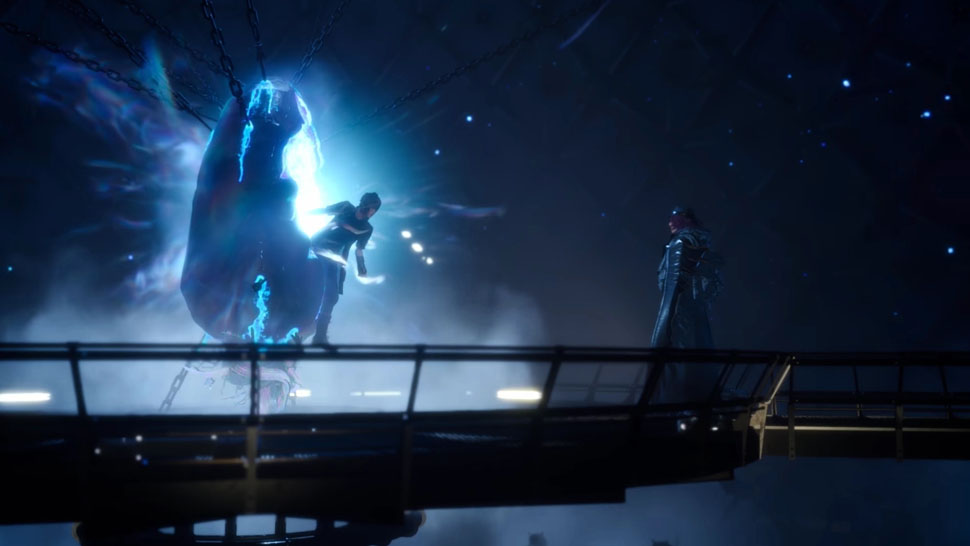
Crystal Taking Noctis

The clues and lore littering Final Fantasy XV tease a thoughtful story, hint at deep themes and characters, and build players’ expectations for a satisfying conclusion. Overall, the game fails to deliver these promises, but its strongest elements show the potential Noctis’ story had if only he had told it.

His skepticism makes him stand out when duty and ancient texts motivate everyone around him. As a child, Noctis asks Luna challenging questions about himself. “If the crystal belongs to everyone, how come only Lucis gets to use it?” When Luna tells him only the chosen Lucian king can use the crystal to save the world, Noctis asks, “You really think I can do that?” Still without adequate answers, his skepticism follows him into adulthood. “Legend has it the King once stood alongside the Six to banish the darkness,” Ignis says. “‘Darkness’ seems awfully vague,” Noctis observes. “A king is sworn to protect his people,” Cor says. “And yet [my father] chose to protect only one prince,” Noctis responds. “Was that his calling? Forsake the masses to spare his own son?” The uninformative answers he receives make one wonder if Noctis’ advisors hide a dark secret from him, if the crystal belongs to Lucis, if it truly chose Noctis, and if Lucis somehow caused the spreading darkness.

Noctis does a poor job emphasizing Luna’s importance to him in the final game, but if used effectively, she had great potential to both motivate and corrupt him. Noctis spends the game’s first half pursuing Luna, always one step behind her. He begins with a journey to marry her but transitions to following the trail of gods she summons, knowing that each she calls drains her strength. Finally, he reaches her only to see Ardyn, a mysterious man of the empire, murder her. Luna, who even as a child understood Noctis’ destiny better than he did, dies with a smile on her face and Noctis’ secrets in her mind. As if Noctis pursued his nebulous destiny only for her, he laments, “All I wanted was to save you.” He puts his quest on hold, even refusing to wear the magical Lucian ring she died delivering to him. With his means of summoning the Six gone, he’s reached a dead end.

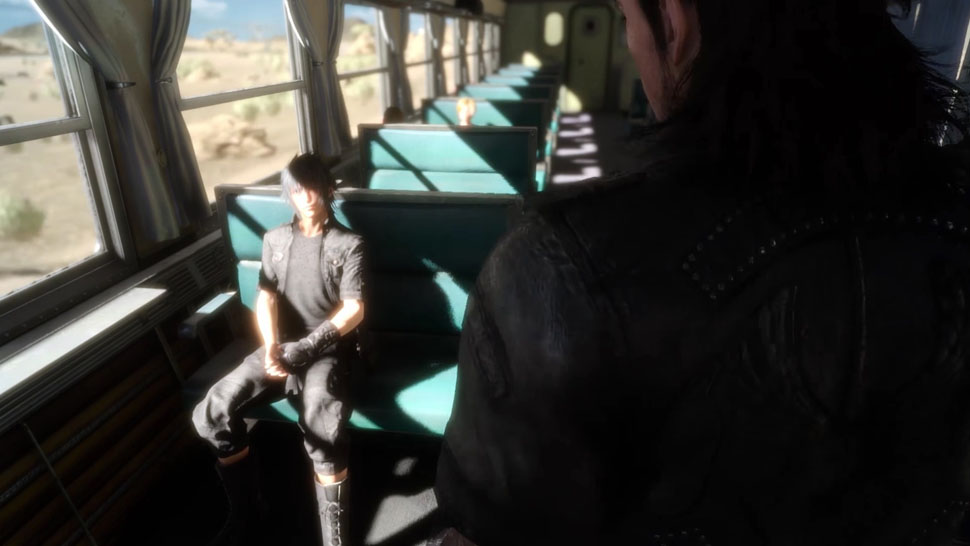
The first scene with Noctis after he grieves Luna’s death opens with him illuminated in a blinding ray of sunlight. While light often symbolizes goodness or clarity, the exaggerated and unnatural lighting in this scene creates the feeling that something sinister and dark festers in the king of light. Indeed, players soon learn Noctis’ rage and despair has driven him apart from his friends, and he looks at the ring as if it holds a malicious temptation he fights against satisfying. Bent on revenge and aggravated by Ardyn’s illusion magic Noctis chases Ardyn up and down the train to Tenebrae until he realizes he’s pursuing a figment of his imagination or, worse, Prompto.

Noctis in the Light

The game offers a simplistic reason for Noctis’ lost abilities, but explanations with personal significance to him, derived from the clues presented within the game and surrounding media, instantly produce more satisfying scenarios. When his powers stop working and he learns Ardyn’s true identity, Noctis has even more reason to question his own identity and abilities. Losing his magic after his dark experiences on the train suggests that the scourge has corrupted him, leaving him unable to grasp the power the crystal grants him as a Lucian king. Perhaps the scourge begins as a darkness in the heart and then becomes a mental and physical disease. Such a condition could jeopardize his ability to fulfill his destiny.

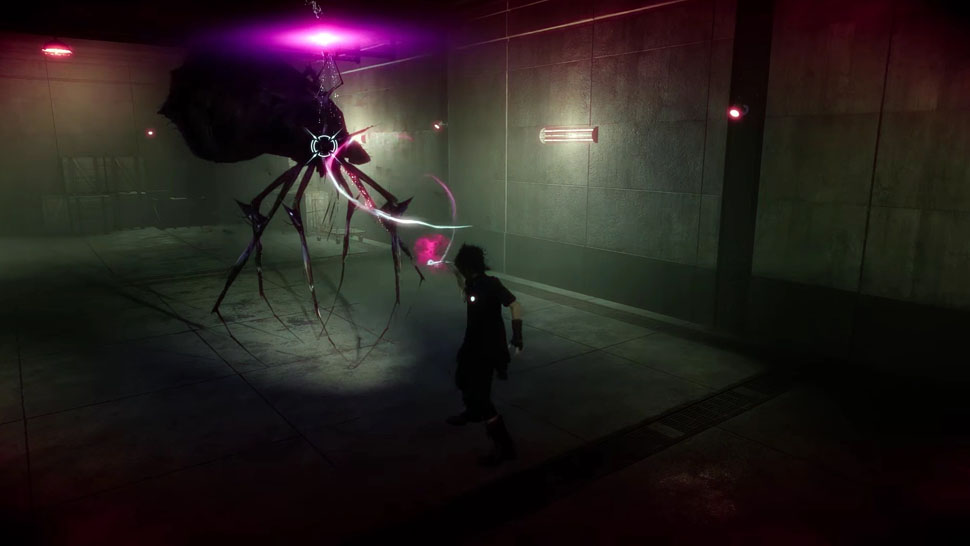
The burden the ring has on Noctis’ mind and his use of it visually and audibly support that it corrupts him. When Noctis’ uses it, players hear whispering like that of demons in horror movies. The Ring of the Lucii glows red. Fire-filled cracks appear on Noctis’ face and arms. As if he’s opened the gates to hell itself, nearby daemons shrivel and explode out of existence. Streams of light flow into Noctis’ hand, and he receives a health boost, implying he’s absorbed their power. If he does absorb them though, what stops them from corrupting him as they corrupted Ardyn? Perhaps Ardyn used the ring to absorb daemons into his body two thousand years ago and has since passed it to the Lucian kings with the myth that it holds great power when in fact it corrupts the wearer.

Events in the Kingsglaive movie provide another alternative scenario for why Noctis loses his abilities. King Regis’ knights lose their magic when Regis dies because he lent them his abilities and can no longer power them after death. If Noctis weren’t a Lucian king, Regis could presumably lend him his power as well. When Ardyn reveals himself as Ardyn Lucis Caelum, he adds, “You’ll never guess who Izunia was.” Perhaps he means Noctis’ ancestors were Izunians who took the Lucian name after ostracizing Ardyn. Ardyn could have lent the fake Lucians his power to make them think they wield and protect the light. Now as part of his revenge, he crushes their hope of defeating him by revealing they never had any power to banish the darkness.

Noctis spends little on-screen time contemplating his destiny, but this simple action could have given him more agency and better tied the story’s loose ends. Inside the crystal, Bahamut answers the question Noctis has had since his father’s death. Perhaps his father and Luna hid so much and treated him so gently because they knew his fate. His desire to protect his friends from Ardyn, avenge those who have suffered under him, and redeem his own ignorance and corruption could give Noctis the determination to meet his death.

Noctis Exploding a Demon

This interpretation of the game’s story may sound decent, but it accentuates and omits details to highlight its strengths. In reality, Noctis does not exist often enough to bring these themes and ideas to life. He has thoughts and emotions only often enough to contradict himself and alienate the player.

Noctis’ naivety quickly disappears, leaving players in the dust. He may not know much about the Lucian weapons he must collect, but he recognizes when Luna summons gods before players even know she can do that. He greets a mysterious lady Gentiana like an old friend and accepts more duties from her with little explanation as to who she is. Noctis takes it for granted that Ardyn can perform illusion magic, leaving it to loading screen text to explain it to the player.

He almost completely ceases questioning his duties in the same conversation where he shows the most frustration with how little he knows about them. Noctis wonders why his father would entrust protecting the people of Lucis to him when he hasn’t even bothered to prepare him for the task. Cor sates his frustration with, “He always had faith in you, that when the time came, you would ascend for the sake of your people.” Yet another synonym for “it is your duty.” Gladiolus questions Noctis at a couple future points, but players select Noctis’ response. He can either show ignorance and skepticism or resolve. These responses have no effect on the story though, making Noctis either a king who deeply questions his abilities but doesn’t care enough to investigate or a king who has resolved to save the world with a friend prone to pointlessly bickering with him.

Admittedly, the story doesn’t give Noctis many reasons to question his destiny anyway. Anyone else proclaiming themselves the Chosen, such as Niflheim’s Emperor Aldercapt and Luna’s brother Ravus, are obviously wrong or evil mustache twirlers. The moral ambiguity Lucis portrayed in Kingsglaive doesn’t continue far beyond it. The people outside Lucis’ capital city, who hated Regis’ decision to give their homes to the empire in exchange for peace in the film, don’t seem to exist in the game. Nothing suggests that Noctis’ mission has terrible consequences or actually makes the situation worse. No one has an alternative method to ridding the world of darkness, so Noctis and his friends must try this one by default, even if they didn’t have prophecies to assure them they have chosen the correct path.

Noctis’ lack of contemplation, however, results in a boring and insincere tale. Noctis pauses his journey, not because he legitimately questions his identity and actions, but because the whiny prince sets his arbitrary duties aside to mope. Noctis doesn’t lose his powers because his ancestor sent him down a path of corruption or because he never inherited Lucis’ gifts. He loses his powers because a random Niflheim invention disables him when someone turns it on. Supposedly, Noctis’ tale stars a prince who must get rid of his “slack jaw” and become a king, but by the game’s end, Noctis has matured only by growing a beard. His ever-increasing power and continuing blind belief in a prophecy hardly count as wisdom. Showing his contempt for introspection and critical thinking, he doesn’t wonder where the Starscourge originated or if he can find a way to defeat Ardyn without killing himself just because his ancestors demand it.

Luna

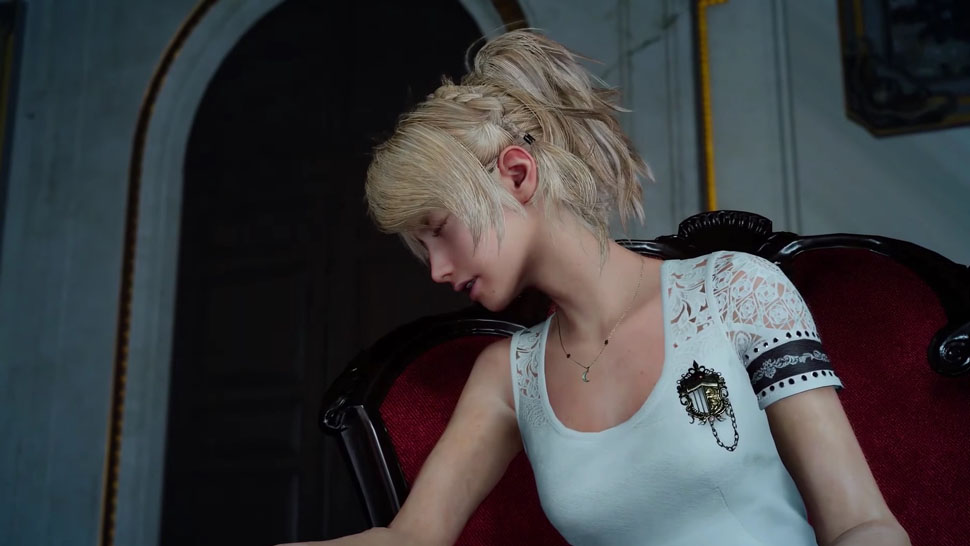
While the idea of a prince pursuing his love across the land only for revenge and solitude to corrupt him sounds compelling, Noctis delivers it poorly. He and his friends discuss the burden Luna carries just ahead of them but only while the player explores the world. Luna slowly weakening and potentially dying receives less emphasis than Ignis announcing that he’s come up with a new recipe, and Noctis and his friends discuss it as lightheartedly as his terrible driving habits. Ravus arguably mentions her struggles in a cutscene when he says to Noctis, “You receive [Ramah’s] blessing. And yet you know nothing of the consequences.” He doesn’t make it clear, however, if his warning refers to Luna’s condition, and Noctis and his friends don’t care enough to wonder. Poor Luna receives so little attention that players can easily miss these details and see her as a distressed damsel who faints into armchairs for no reason.

Noctis not only doesn’t care about Luna’s burden, but also, he doesn’t care that she carries it for him. He laments Luna’s death not because her duty to serve him sapped her strength until it killed her but because a bad guy decided to stab her. Like a cliché, he laments that he couldn’t save the woman he loved instead of wondering why yet another person who understood his destiny sacrificed herself without telling him how to proceed. Gladiolus is too busy calling him a mopey teenager for either of them to notice that Noctis can’t contact the remaining three gods to complete his quest. Ardyn murdered the one person who can summon them. Fortunately, Shiva decides to reveal herself by freezing Noctis, Gladiolus, and Ignis half to death for no reason. Bahamut and Ifrit also reveal themselves unprovoked. Thus, Luna becomes an inconsequential side note in Noctis’ journey.

In fact, Noctis’ indifference belittles and muddles most of the story’s biggest revelations. Ardyn’s illusions could make a prince, who already questions his destiny, question his senses and the people around him. Instead, Ardyn’s random and pointless use of his abilities mostly just annoys Noctis. Noctis struggles desperately while the crystal slowly absorbs him, but then, he contentedly spends the next decade hibernating inside it. Ardyn reveals himself as a Lucian king, but Noctis doesn’t reflect on what that means for his own identity. Players spend the game collecting the weapons, souls, and powers of thirteen dead kings, the favor of six gods, and a magic ring and crystal only to discover that Noctis still has to die to gain the power to defeat Ardyn. Everything Noctis does seems like a pointless ritual to prove himself the Chosen when everyone already knew that. His arrogant ancestors apparently think the Lucian line can end, and they will never need to defend the world from the Starscourge again. But Noctis doesn’t see his destiny as unfair or arbitrary nor does he so much as wonder how much his father or Luna knew of his fate.

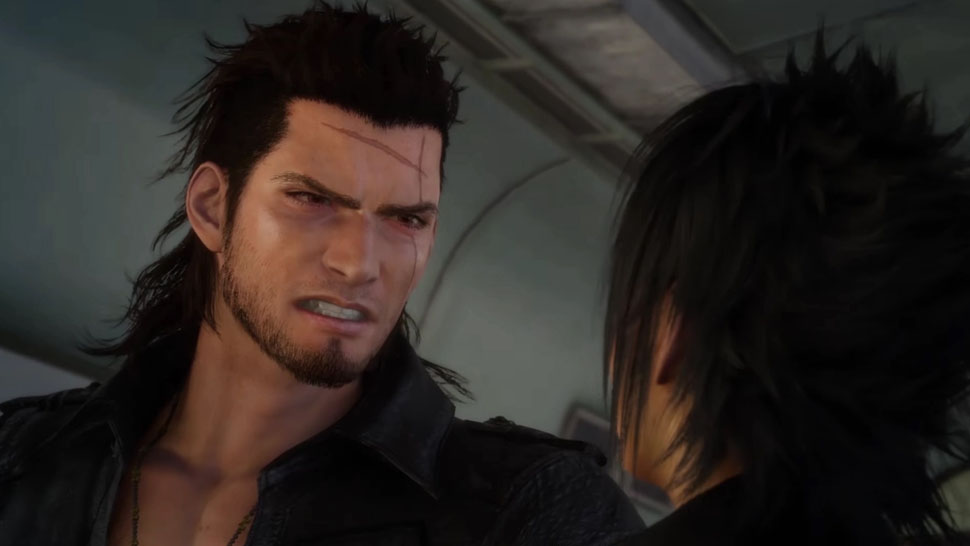
Noctis and Gladio Bickering

Without Noctis, even Final Fantasy XV’s blatant brotherhood theme doesn’t quite translate in the end. The infamous Chapter 13 attempts to emphasize the importance of Noctis’ friends through their absence. Noctis wanders Gralea’s scary and lonely corridors while Ardyn taunts him for his powerlessness without his companions. Ardyn can’t convince anyone, however, with Noctis opening hellish portals and exploding daemons into screaming fireballs, which Noctis doesn’t find at all disconcerting by the way. Ardyn also tries to torment him with illusions, but rather than becoming paranoid and desperate, Noctis recognizes the tricks and snarls with annoyance.

These failed tactics instead reveal the uselessness and superficiality of Noctis’ friends to the story. Noctis fights and defeats Ardyn by himself. His strength comes from kings, gods, rings, and crystals, not from the brothers around him. He doesn’t need them to tell him to do his duty. He doesn’t need them to tell him to move past Luna’s death. He never refuses to continue his quest, and he wears the ring on his own terms. He doesn’t need them to help him separate reality from illusion. He doesn’t need them to save him from corruption. They don’t transform him from a prince into a king, if he didn’t leave the castle as a king from the start. He doesn’t fear facing Leviathan, Bahamut, or Ardyn by himself. He cries the final time he sits around a campfire with his companions, but why? Does he wish his journey didn’t end in a path he must walk alone? Does he think of the hole his death will leave in his friends’ hearts? Does he mourn the life he will never know with them by his side? Is he only grateful they walked with him this far? Without Noctis to define what they mean to him, Ignis, Prompto, and Gladiolus exist only as replaceable clichés to entertain players on their journey.

Final Fantasy XV asks the player to “reclaim your throne,” not to “reclaim Noctis’ throne,” and for this reason, unlike Tidus, Noctis never has the chance to say, “Listen to my story.” The game contains elements of an emotional and compelling tale, but Noctis’ emptiness transforms it into a shallow and confusing one. Players who can project themselves into Noctis and fill the gaps around him with their own speculation and experiences can fall in love with the world, its ideas, and its characters. The players looking for Noctis’ story, however, will only find the void he left behind.

Final Fantasy XV Brotherhood